- Taking Data Visualization From Eye Candy to Efficiency
- Fuck Nuance, a manifesto for more bold social theories, by Kieran Healy (via Analise Real)
- Machine Learning Classes at Oxford (videos, presentation and code)
- 2015 Ig Nobel prizes: a study shows that nearly all mammals take the same amount of time to urinate (about 21 seconds)
- There is a Space Syntax Toolkit for QGIS (ht Renato Saboya, who runs a great blog about urbanism written in Portuguese: Urbanidades)
- 10 things you need to know about the Magna Carta
- Slum tourism and its discontents. Not exactly a new article but a good summary of arguments (ht Fabiana Freitas, my lovely partner)
- The Value of Democracy: Evidence from Road Building in Kenya [unagated paper]
-

Showing posts with label space syntax. Show all posts
Showing posts with label space syntax. Show all posts
Sunday, September 27, 2015
Assorted Links

Sunday, June 28, 2015
Assorted Links
- Tyler Cowen on Who benefits most from Uber?
- Volcano urbanism
- Which chart should you use to show this data?
- The LSE Cities program is hiring a spatial analyst. The closing date for applications is 12 July (ht Juliano Spyer)
- Where are the World's Straightest Roads?
- Paul Roemer on Urbanization versus GDP per Capita
- Environment Agency makes LiDAR data open in the UK
- Robot opera singer premieres in Berlin
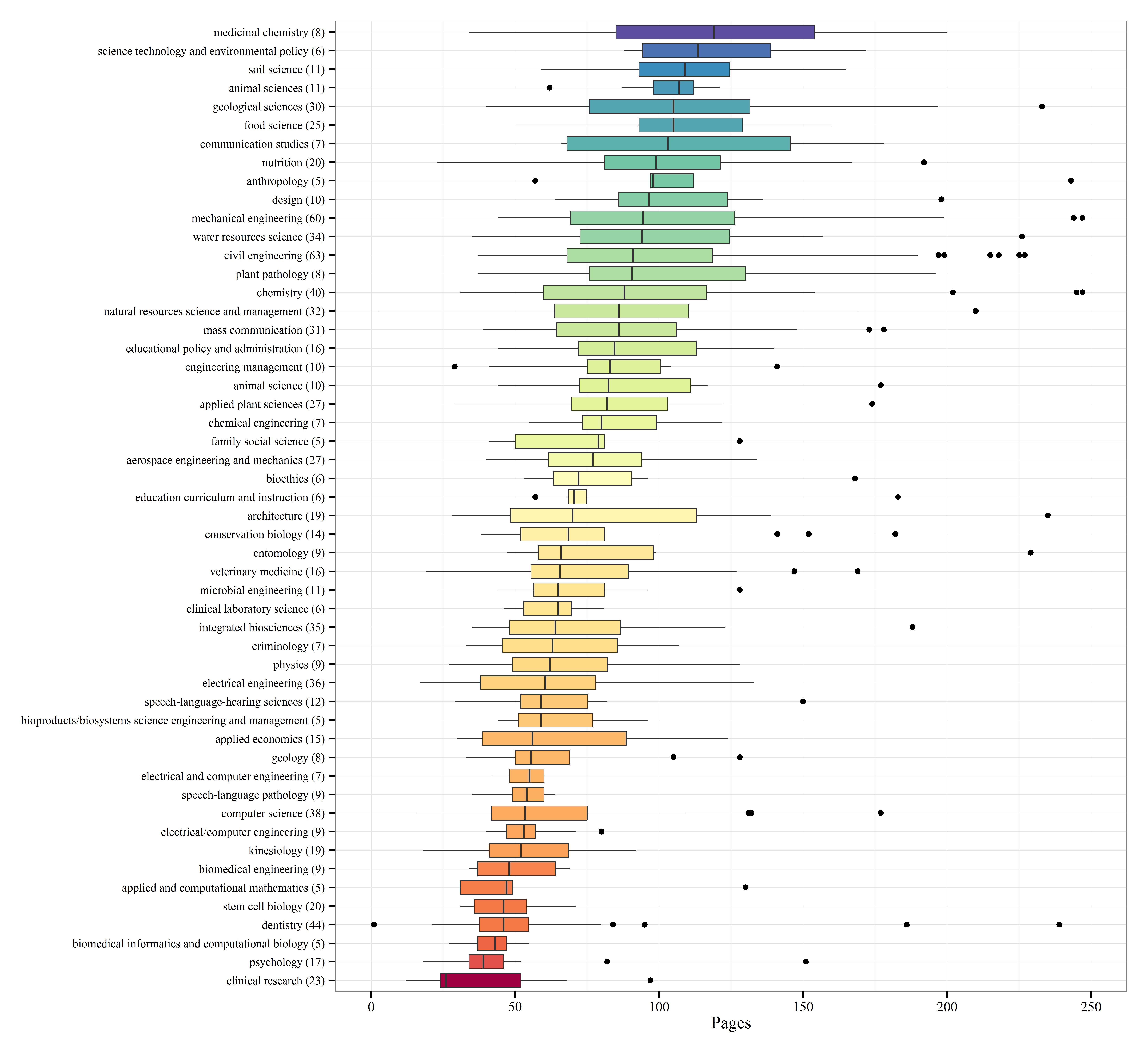
- Length of the average master’s thesis in different fields of study (via Nathan Yau)
[image credit: bckmw]
Thursday, February 5, 2015
Assorted links
- Skype Translator is on the way via MR
- Paris's history, captured in its streets (using R!)
- Compare the actual size of countries
- Flowcharts
- A systematic approach to interactive visualization and algorithms
- The Evolution of Moscow's Subway Maps
- Serious scientific progress
- Other things I would rather be doing
- According to UN projections, nearly 9% of the world’s population will be living in just 41 megacities by 2030. Great Dataviz by The Economist

Monday, May 5, 2014
Assorted links
- Contribute to a survey on the connection between the built environment and personal health: It took me 3 minutes to answer this short questionnaire. The survey is organized by our loyal reader Benjamin Littenberg.
- Why do birth rates peak at different times in different places?
- Longer commutes in Britain (via Peter Gordon)
- An ageing economy will be a slower and more unequal one
- Great piece by Simon Jenkins on the coming Mega Events in Rio
- Space Syntax of street connections in the Greater South East of England
- Gary S. Becker has passed away. Many interesting links about his work at MR
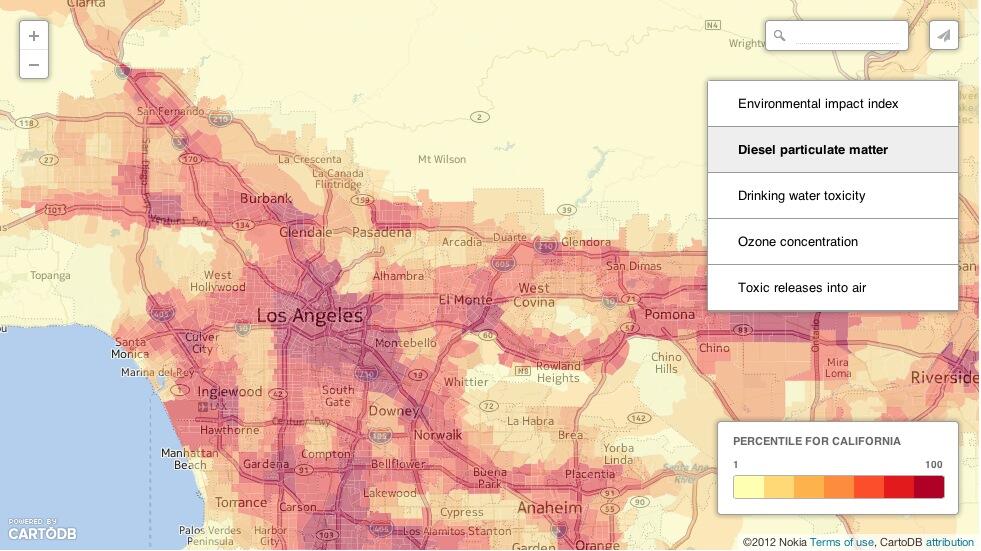
- The Pollution Burden in California by census tracts (via Stephen Miller)
[image credit: LA Times]
Wednesday, December 11, 2013
Assorted Links
- Road pricing: What’s not to love?
- Top 20 things politicians need to know about science and Top 20 things scientists need to know about policy-making (ht Paulo Nascimento)
- Turning-point years in history according to the most frequent dates used dissertation titles
- Up all night to get data, a music parody
- San Francisco Aerial Views. 1937-1938
- Urban street networks, a comparative analysis of ten European cities
- Declining fertility rates will transform the Asian family
- Coldest spot on Earth identified by satellite (minus 93.2 Cº)
- Snapshot: Global Migration
- African polygamy over space and time

Thursday, August 8, 2013
The Haussmann Effect
A recent study by Marc Barthelemy and colleagues analyzing more than 200 years (1789–2010) of the evolution of the street network of Paris. This paper has just been added to my reading list. (via Emily Badger). By the way, Micahel Batty and his team at UCL have done a similar study analyzing the evolution of London’s street-network over a 224 year-period (1786-2010).
Barthelemy's Abstract:

Related links/posts:
Interventions of central, top-down planning are serious limitations to the possibility of modelling the dynamics of cities. An example is the city of Paris (France), which during the 19th century experienced large modifications supervised by a central authority, the ‘Haussmann period’. In this article, we report an empirical analysis of more than 200 years (1789–2010) of the evolution of the street network of Paris. We show that the usual network measures display a smooth behavior and that the most important quantitative signatures of central planning is the spatial reorganization of centrality and the modification of the block shape distribution. Such effects can only be obtained by structural modifications at a large-scale level, with the creation of new roads not constrained by the existing geometry. The evolution of a city thus seems to result from the superimposition of continuous, local growth processes and punctual changes operating at large spatial scales.
Figure 2: (a) Map of Paris in 1789 superimposed on the map of current 2010 Paris.In the whole study, we focus on the Haussmann modifications and limited ourselves to the 1789 portion of the street network. (b) Map of Haussmann modifications.
[click on the image to enlarge it]

- The evolution of road networks
- Assorted links on Space Syntax
- Assorted Links on S. Syntax and Accessibility
- Extracting Feature Geometries from OpenStreetMap
- The amazing David Rumsey Database of historical maps
Wednesday, October 10, 2012
Assorted Links
- Is It Better to Buy or Rent? (via Patrik)
- Neil Smith (the father of the Gentrification theory) has passed away.
- New survey paper on what economists know about “brain drain”/“brain gain”). via MR
- The New Science of Viral Ads by Thales S. Teixeira (Harvard)
- Germans are five times more likely than Americans to travel by mass transport (the paper is here)
- Book: The Demography of Health and Healthcare
- The demographic transition may be the result of a mismatch between ancient psychology and the modern world (via @blqueiroz)
- Call for Abstracts: 9th International Space Syntax Symposium
- Car use is peaking in the rich world

[image credit: The Economist]
Tuesday, July 10, 2012
Assorted Links
-
- Rise in housing prices around the world from 2001 to 2011 Where is the bubble?
- The recent debate on City v. Suburban Growth in the US here and here (maybe some people are being a little bit hasty about this)
-
-
-
- London’s Daytime Population

Tuesday, May 1, 2012
The evolution of road networks
A quantitative analysis of how unplanned street networks evolve over time (via Per Square Mile and M. Batty).

You may also try to replicate the study for different cities.
- Paris 1550 (HT Leo)
- Manhattan, NYC (1807) and here
- London, 1746 and 1869
- São Paulo 1958
- Minneapolis 1895, 1899, 1910 (via David Levinson)
- Don't forget the David Rumsey Map Collection Database
Monday, March 19, 2012
Workshop on "Urban Syntax"

My dear friend Valério Augusto Soares de Medeiros (CV) is going to teach a workshop on Urban Syntax at the Department of Civil Engineering and Architecture - Technical University of Lisbon (UTL).
More information here and here.
Break a leg!
Friday, March 16, 2012
Spatial Layout Efficiency (Space Syntax)
An informative presentation by Tim Stonor on Spatial Layout Efficiency, where he explains the fundamentals of Sapce Syntax and its applications in modelling the urban space.
ps. And our modest contribution to the topic: Spatial Layout Efficiency in terms of travel time.
Tuesday, February 7, 2012
Why some city streets are more crowded than others
The Economist Magazine has written two interesting articles on 'Crowd Dynamics' over the last two months (here and here). Very informative about the contribution of space syntax to urban planning.
By the way, some presentations from SSS8 are now available (HT Valerio Medeiros)

Thursday, January 12, 2012
Assorted links on Congestion

[image credit: Jacob]
- Why Building Roads Creates Traffic? “The Fundamental Law of Road Congestion: Evidence from US Cities” discussion paper here (HT Leo)
- Congestion costs in Australia
- Braess paradox: “Put simply, the paradox ... says that adding a new road to a transportation network, rather than making things batter, may actually slow things down for all its users” (Vanderbilt in Traffic). We have just presented a working paper at the 8th Space Syntax Symposium that analyses the relationship between street-network connectivity and travel time variability. Well, It's jus a working paper but the results suggest that the Braess paradox should be the exception.
- The Case for Congestion Pricing
- "Congestion is a bit like cholesterol - if you don’t have any, you die"
- The Brazilian government has just signed a federal law that gives municipalities the legal support to implement congestion pricing schemes (revenue must be provided to public transportation) - written in Portuguese only.
Monday, January 2, 2012
8th Space Syntax Symposium (2012)
The 8th Space Syntax Symposium starts tomorrow. Plenty of interesting papers !
Unfortunately, I will not attend to the event. However, Frederico de Holanda will present a paper of ours at the conference (break a leg!)

Friday, December 23, 2011
Assorted links
- Here you can listen to the full Beatles discography (at the same time!) "Massive mash up"
- Some really
absurdinteresting photos of Las Vegas Landscape
- Bike share program in Rio de Janeiro Let me assure you it's pretty simple to use it.
- Evolution of the London Underground Map 1889-2002 (HT Leo)
- Opportunities at Brown University - BIARI program (HT Ricardo Ojima)
- The Best Data Visualization Projects of 2011

Wednesday, December 14, 2011
Exceptional Space - book recommendation
I would like to reccomend a book for those Space Syntax enthusiasts: Exceptional Space by Prof. Frederico Holanda (this is the English edition of his doctoral thesis, supervised by Professor Bill Hillier). I have read the portuguese version and it is a terrifc book for urban planners, geographers or sociologists with focus on the spatial dimension of human relations.

Thursday, October 13, 2011
Assorted Links on S. Syntax and Accessibility
- Quote: "[Congested] road segments are only the appearance—they're not the problem" Yu Zheng
- Quote: "They found that when city planners added new connections between regions that algorithms had identified as flawed, conditions did indeed improve."
- Understanding the link between street connectivity, land use and pedestrian flows
- A good post on Connectivity by Old Urbanist
- Alasdair Turner passed away (the man behind Depthmap®)
- When it comes to Accessibility one should know David Levinson.
Thursday, May 12, 2011
"Old concepts for the city's future"
A pretty good video about São Luís* with a transportation proposal for the city (by Diogo Pires Ferreira). The video is based on his MA. Project called "The rescue of old concepts for the city's future".
*a city in the northeast of Brazil
Monday, February 28, 2011
Assorted links on Space Syntax
- All streets (Ben Fry) -All of the streets in the lower 48 United States: an image of 26 million individual road segments. Now that's a map I would love to see converted into an axial map!
 Some really old maps of South London [Space Syntax researchers, how about doing a comparative historical analysis?] via Nettoworks.
- Have you heard about Typographic Maps? Depicted cities with textual elements! And you thought the creation of an axial map was laborious. Via Jonathan Crowe.
- 3D Space Syntax (ok, that's new for me!)



Thursday, October 28, 2010
Potential bridge: OSM and Space Syntax boring
Jonathan Crowe came up with this video down here (via OpenGeoData). It's pretty impressive how collaborative people can get and share public datasets on streets information around the world. [This video here is more surprising though]
Whenever I hear about the OpenStreetMap Project I can't help thinking about Space Syntax. Hand drawing an axial map is really boring and takes a lot of time too! The point is: Does anyone have any idea on how to convert OSM data to space syntax softwares?
Subscribe to:
Posts (Atom)