Showing posts with label USA. Show all posts

Wednesday, March 13, 2019

Racial inequity in who pollutes and who gets exposed to pollution

A recent paper led by Chris Tessum (University of Washington) and published in PNAS brings novel estimates of racial-ethnic disparities in air pollution cause and exposure in the US. They find that air pollution is disproportionately caused by consumption by white Americans, but disproportionately affects Black and Hispanic Americans. The air pollution input-output model used in the paper is freely available and there's an experimental live version of the model running, here. (thanks Marko Tainio for pointing to this paper)

Abstract
Fine particulate matter (PM2.5) air pollution exposure is the largest environmental health risk factor in the United States. Here, we link PM2.5 exposure to the human activities responsible for PM2.5 pollution. We use these results to explore “pollution inequity”: the difference between the environmental health damage caused by a racial–ethnic group and the damage that group experiences. We show that, in the United States, PM2.5 exposure is disproportionately caused by consumption of goods and services mainly by the non-Hispanic white majority, but disproportionately inhaled by black and Hispanic minorities. On average, non-Hispanic whites experience a “pollution advantage”: They experience ∼17% less air pollution exposure than is caused by their consumption. Blacks and Hispanics on average bear a “pollution burden” of 56% and 63% excess exposure, respectively, relative to the exposure caused by their consumption. The total disparity is caused as much by how much people consume as by how much pollution they breathe. Differences in the types of goods and services consumed by each group are less important. PM2.5 exposures declined ∼50% during 2002–2015 for all three racial–ethnic groups, but pollution inequity has remained high.


credit: Tessum et a..

Monday, March 19, 2018

"Even wealthy families, good neighborhoods and two parents can’t protect black boys from racism"

The title is this blog post comes from Emily Badger (Twitter), who has written a great piece for the NYT, covering the latest study of Raj Chetty and colleagues. Using a unique dataset, the study shows that black men consistently earn less than white men, regardless of whether they're raised poor or rich. The full paper is here.

The study is part of The Equality of opportunity Project, an ambitious and groundbreaking project led by Chetty. I've posted about the project in this blog a few years ago.


Friday, February 5, 2016

Historical international immigration to the US 1850-2010

John Weeks points out to this interactive map of international immigration to the US, based on population census data (1850 - 2010) .

This is probably one of the nicest dataviz of migration patterns I've seen and yet this is just one piece in a much broader project to build an atlas of the US History at the Uni. of Richmond.


Tuesday, March 19, 2013

Wednesday, March 6, 2013

Wealth Inequality in the USA

A friend of mine pointed me out to this study by Michael I. Norton (Harvard) and Dan Ariely (Duke) where they contrast the current distribution of wealth in the USA to the ideal level of wealth inequality expected by americans.

Here are the results condensed in 6 min.

Wednesday, January 30, 2013

Average Traffic Density of US Highways (1944)

Eric Fischer has found this awesome map showing the predicted average traffic density of US highways in 1944 (via Tim De Chant). Since they didn't have the GIS technology we have today, how do you think they did this? 

[Click on the image to enlarge it]

Related Links:

Monday, January 21, 2013

American life expectancy lags behind

Interesting comments by Gary Becker and Richard Posner on why American life expectancy lags behind other developed countries.

Monday, January 14, 2013

Monday, January 7, 2013

Isochronic maps of American railways in the 1800s

We have already seen some Isochronic maps here at Urban Demographics Blog. Here are a couple of travel time maps for rail mode in the US using New York City as a starting point (1800, 1830, 1857 and 1930). Via Nathan Yau.

Time to get from New York City to almost anywhere in the US, in 1857.
[Image Credit: the 1932 Atlas of the Historical Geography of the US, via Michael Graham Richard]

Monday, November 26, 2012

The Richest Cities in the US in 1978 and Now

A study by McKinsey Global Institute showing the richest metros in the US in 1978 and now (via Jordan Weissmann).

[Click on the image to enlarge it]

Thursday, June 28, 2012

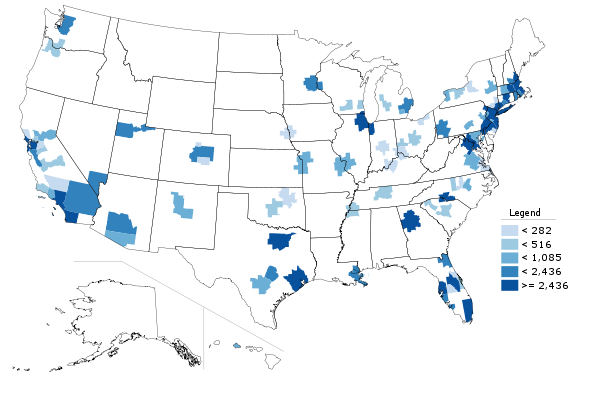
BRIC's population in US metros

Aaron (Urbanophile) has done this analysis showing how many Brazilians, Russians, Indians and Chinese are living in US metropolitan areas. We are not as many as I thought and we are by far fewer when compared to other BRIC countries. Click here to take a closer look.

Total Brazil born population by metro (2010)
[image credit: Urbanophile]

Soundtrack: Tim Maia