Showing posts with label Agglomeration. Show all posts

Tuesday, November 6, 2018

The top cities by scientific output in 2018


The group Nature has updated the Nature Index and published a special issue raking cities and metro areas by their scientific output. There is a vast literature on cities as engines of growth and creativity because of economies of agglomeration, proximity and face-to-face contacts, social and cultural diversity etc. It's interesting to see how scientific outputs are clustered around major urban areas in the world.


The method they used to define urban clusters, however, is not entirely clear.  It seems a bit odd to me that they put Columbia, Princeton and Yale Universities in the same 'New York' cluster given the distance and commuting ties between these urban areas. My guess is that based on the same criteria, London-Oxford-Cambride (UK) should also be considered as a single cluster but they are treated separately. The same would happen with Sao Paulo-Campinas-Sao Jose dos Campos (Brazil).

In any case, the report brings plenty food for thought, including this brief analysis showing that the top collaborating cities are located in the same country.

Monday, November 25, 2013

The determinants of agglomeration in Brazil: input-output, labor and knowledge externalities

Aguinaldo Maciente is a great colleague of mine at Ipea. He finished his PhD at Illinois (Urbana-Champaign) a few months ago. It could be particularly interesting to those readers working in Regional Science, Migration studies, Labor Markets and Geographic Labor Mobility.

Thesis: The determinants of agglomeration in Brazil: input-output, labor and knowledge externalities.

Abstract:
This research investigates industry agglomeration and coagglomeration patterns in Brazil, and assesses their association with the Marshallian forces that are commonly viewed as sources of agglomeration economies, namely the input-output and labor pooling externalities. Knowledge externalities, the third classic source of Marshallian agglomeration economies, are partially captured through labor-embodied knowledge usage. [...] The ONET database, which contains several skill measures for US occupations, is matched with Brazilian occupations and factor analysis is used to produce a set of ONET skill and knowledge groups. These skills groups are intended to describe the labor profile of industries and regions and constitute the basis for measures of labor and labor-embodied knowledge externalities for pairs of industries. The measures of input-output linkages and labor-use similarity are related to the observed agglomeration and coagglomeration patterns, in order to test for the possible sources of agglomeration economies in Brazil. Results indicate that Brazil has agglomeration levels, as measured by Ellison and Glaeser’s (1997) agglomeration index, that are slightly decreasing over time, but comparable to the international experience. However, the components of the agglomeration index reveal that Gini-type regional employment concentration and plant-level employment concentration are relatively high, despite their decrease from 1994 to 2010. That is, Brazil has most of its employment concentrated into relatively fewer regions and plants, when compared to results found in the literature, for example, for the United States. [...] Overall colocation patterns in Brazil seem to be more associated with labor and labor-embodied knowledge externalities than with input-output externalities. Natural advantages, such as agricultural and mining potential and road density are also positively associated with observed coagglomeration [...]

Tuesday, August 28, 2012

Densification vs. De-densification of Manhattan

This map (posted at Urbanization Project) compares census tract densities in Manhattan between 1910 and 2010 (via Aaron M. Renn from Urbanophile). And some people think Manhattan is too dense now.


Of course it was totally different times (i.e. smaller car fleet and less transportation infrastructure).

Monday, April 9, 2012

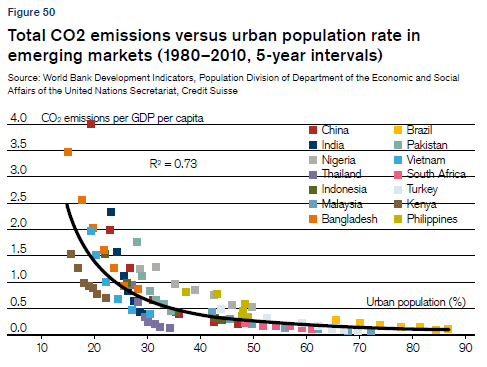
CO² emissions vs Urban Population Rate

An interesting graphic from the recent Credit Suisse report on global urbanization trends  (via Alex Tabarrok, via Gulzar).

[Image Credit: Credit Suisse report]

Wednesday, January 18, 2012

2011 Global MetroMonitor

The Brookings Institute recently released their 2011 Global MetroMonitor, which analyses the economic growth in the world’s 200 largest metropolitan economies (including five Brazilian metropolitan areas).

It looks pretty interesting. For instance, "ninety percent of the fastest-growing metropolitan economies among the 200 largest worldwide were located outside North America and Western Europe". More here and here

View the interactive map for economic statistics on individual metro areas


soundtrack: que pena

Monday, November 28, 2011

Untangling the City

A new CASA Working Paper by Michael Batty. I will probably take a few hours to really understand the paper. But I'll try it !

[image credit: ?    I love this image. It reminds me of a movie scene from 'Inception']

According to M. Batty, the paper describes "the transition from thinking of ‘cities as machines’ to ‘cities as organisms’". I wonder what could be clinically diagnosed as an urban cancer...


soundtrack: Beck

Saturday, August 6, 2011

The death of distance and the rise of cities

Glaeser gave this lecture on November 13, 2008, at LSE. This event marked the launch of the Spatial Economics Research Centre.


He starts talking about this apparent paradox "The death of distance and the rise of cities" (audio only). In this lecture he tackles regional policy and declining cities, urban sprawl, urban environment and gas emissions, density, affordable housing and all other trending topics in urban studies you should be aware of.

Tuesday, March 15, 2011

Glaeser at LSE


Professor Glaeser presented a lecture at LSE promoting his new book "Triumph of the City". Listen to podcast here (approx 60 min). You can watch here a short and funny interview with Glaeser at the Daily Show promoting the book.

It's all about agglomeration, agglomeration, agglomeration, but not too much.

Wednesday, February 16, 2011

Short interview with Glaeser

A short and funny interview with Glaeser at the Daily Show promoting his new pop book. His conversation with David Leonhardt (economix) is also worth a read.


Wednesday, September 1, 2010

Friday, August 27, 2010

Why agglomerations exist (Thisse at Ipea)

Prof. Jacques-François Thisse is going to to honour us with a presentation at Ipea (Institute for Applied Economic Research - Brazil). As far as I know, it's going to be broadcast on the internet ! (I will post the link later);


Why agglomerations exist - a New Economic Geography perspective


Brasília, Brazil
Semptember, 1st.
9:30am till 12pm local time. (GMT -3:00) do the math! or click here to make the conversion to your local time.

Thisse is professor of economics at the Université Catholique de Louvain (He is also among the top 5% authors registered inRePEc).
Important: I belive the presentation will be translated to portuguese (and I hope it doesn't disturb the broadcast).