Showing posts with label Demographic Trends. Show all posts

Monday, October 27, 2014

World population and human capital (webcast)

Heads up:

Prof. Wolfgang Lutz (IIASA / Wittgenstein Center) will deliver a public lecture on 'world population and human capital in the 21st century', next week (November 3, 2014 17:00 GMT). This event is also being live webcast on here. The event is organized by the the Oxford Martin School and will be followed by a panel discussion with other demography professors from Oxford.

Prof. Lutz and his team are in the forefront of incorporating educational attainment in population projections and have many influential papers in Nature, Science, PDR, etc.  Highly recommended event! 


[Image Credit: Lutz and KC, 2011]

Tuesday, August 7, 2012

Global Labor Force

The McKinsey Global Institute has published a comprehensive report on global labor market and labor force supply. It includes a forecast of labor force supply and demand through 2030 and tackles several issues such as labor productivity,  population aging and educational attainment. (ht Fabiano Pompermayer)

No blue skies for Brazil.
[Click on the image to enlarge it]

Related Links:

Monday, July 30, 2012

London in figures and Fertility Crisis

The Economist's daily chart addressing London's demographic trends.*


* By the way, they have also published this article talking about the relation between recession and fertility in  Europe. Yes, economic uncertainty can be quite bad for fertility.

Wednesday, March 7, 2012

“We thought we had it nailed”

Alasdair Rae has posted a short analysis of  'Small Area Population Change in London, 2001 to 2010'. He mapped the results using ONS mid-year population estimates for small areas.

But we all know how these kind of demographic forecasts for small areas can become tricky sometimes.

When it came to plan Plan education or health care in London “We thought we had it nailed” says Baljit Bains (head of the Greater London Authority’s demography unit).

[Image Credit: under the raedar]

soundtrack: Metropolitan Jazz Affair

Wednesday, November 2, 2011

The demographic challenge in Brazil

OECD has just published its 'Economic Surveys' on Brazil (thanks Leo for the tip). According to the report, the aging of the population is a major challenge in Brazil. This is not big news, but they say it in a concise manner:

"Like many emerging-market economies, Brazil’s population is going to age rapidly in the coming decade (Figure 1). The share of the elderly population is expected to double in less than 20 years, a transition that took around three times as long for today’s advanced economies. These demographic changes will alter the  macroeconomic environment. Assuming no policy changes, lower working-age population growth could lower potential output growth significantly by the middle of the century. This fall will most probably be partially compensated by the effect of the Growth Acceleration Programme (PAC) on productivity growth, but that impact is hard to estimate. Ageing is also likely to increase savings through life-cycle dynamics, although in Brazil’s case prospects for aggregate savings will depend on the effectiveness of social and labour-market policies in continuing to lower the share of poor households, who traditionally save less. Ageing will also tilt public spending toward greater outlays on old-age pensions and health and long-term care and less on education, but the aggregate impact on public finance is likely to be negative."

Figure 1.  The speed of population ageing*
*Number of years for the share of population 65+ to double from around 10% to around 20%
Note: United Nations population projections have been used. Numbers for France and the United Kingdom correspond to an increase from 12% to around 20%.
Source: OECD calculations

Monday, October 10, 2011

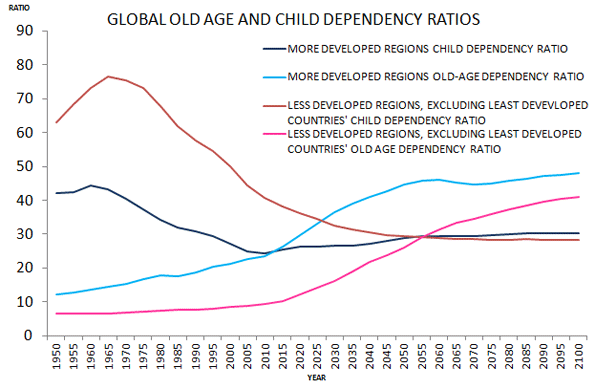
Demographic Dependency Ratio

New Geography have just published a piece by Emma Chen and Wendell Cox on the challenges posed by aging and declining fertility. Worth 5 minutes of your time.


UNDP global old age and child dependency ratios
[image credit: New Geography]

Tuesday, September 20, 2011

Demographic trends in Brazil

Fabio Giambiagi presents (here) what are the main demographic trends in Brazil over the next few decades. Good news: here is no need to panic.... at least not now. (this post was gently stolen from Leonardo Monasterio)

By the way, I would like to share this excellent chart.

Total Fertility Rate in Brazil, Sweden and England, 1900-2000.
[Click on the chart to enlarge the image]


apud Wong and Carvalho (2006) The rapid process of aging in Brazil: serious challenges for public policies. (portuguese version only).

soundtrack for this post: Caetano.

Monday, September 12, 2011

Assorted links

  • Sharon Zukin discussed her latest book at LSE public lectures and events. She explores the social construction of ‘autenticity” in urban spaces addressing gentrification of cities and rent control. Available as: mp3 or Video


Friday, August 19, 2011

Assorted Links

  • The new issue of the Journal of Transport and Land Use (JLUT) focuses focuses on coevolution: how transport drives changes in land use, and vice versa. Here!


Demographics under the spotlight

And a beautiful video composed completely of photographs of Paris (by Luke Shepard via Daniel Lippman)

Monday, November 22, 2010

Demographic trends shaping US metropolitan areas


This is a video report by the Brookings Institution on the demographic trends that have affected US metropolitan areas in the 2000s. The study focuses on the metro scale and stresses five demographic trends that are currently undergoing in the US:

  1. Growing fast
  2. Diversifying rapidly
  3. Aging Tsunami
  4. Selectively educating
  5. Divided by income

The video is realy good and the Full Report looks even better. "The State of Metropolitan America: on the front lines of demographic transformation" Download it here.

ps. You can also explore data for the US 100 metro areas and 50 states (State of Metropolitan America Indicator Map).

ps2. I wonder when we are going to see a report like this on Brazil Demographics...