Showing posts with label Education. Show all posts

Monday, October 27, 2014

World population and human capital (webcast)

Heads up:

Prof. Wolfgang Lutz (IIASA / Wittgenstein Center) will deliver a public lecture on 'world population and human capital in the 21st century', next week (November 3, 2014 17:00 GMT). This event is also being live webcast on here. The event is organized by the the Oxford Martin School and will be followed by a panel discussion with other demography professors from Oxford.

Prof. Lutz and his team are in the forefront of incorporating educational attainment in population projections and have many influential papers in Nature, Science, PDR, etc.  Highly recommended event! 


[Image Credit: Lutz and KC, 2011]

Tuesday, October 14, 2014

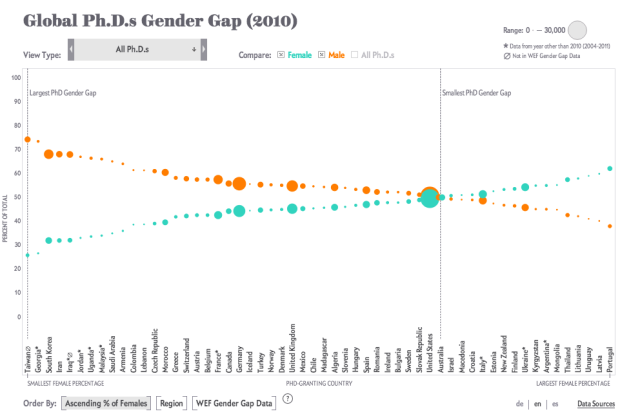
Global Ph.D.s Gender Gap (2010)

Scientific American has recently published an interesting chart showing the gender gap in Ph.D.s across different countries. It's amazing how the distribution varies so much between different fields of study. You should check the interactive version here.


Sunday, January 12, 2014

Higher education in BRIC countries: a demographic perspective

The future of higher education in BRIC countries: a demographic perspective. A new paper published by Raquel Guimarães in the Brazilian Journal of Population Studies (REBEP).

Abstract:
In regard to the development and reform of higher education (HE), recent and projected evidence suggest that enrollment growth is likely to be slower than it is at present (or even negative) as a result of ageing populations. The case of the BRIC countries is particularly interesting for the study of the impact of demographic changes on HE because these countries show considerable diversity regarding their demographic transition. This paper explores how demographic changes are likely to affect the demand for higher education in BRIC countries. I argue that these countries are now facing a great expansion of enrollment but, given declining fertility levels, diversification of the HE clientele will become a common strategy. But diversification of the student population will place a new and complex set of demands on HE institutions, and equity in higher education in the near future will depend on how HE systems are structured in these countries.


Related Links:

Wednesday, December 18, 2013

Peer effect + Neighborhood effect

The interaction of Peer and Neighborhood effects of Bart Simpson, aka 'The Cone of Ignorance' (via FlowingData).


[Image Credit: FlowingData]

Tuesday, October 22, 2013

Demographic papers published on Science and Nature

It's not everyday you see demographers publishing on journals like Science and Nature. So here is a short list with some of the papers published since 2000.

ps. Massive presence of @IIASAVienna and @WiCVienna researchers!

and my two favorites:

[Image Credit: Lutz and KC, 2011]

Tuesday, September 3, 2013

Bicycles access and school enrollment

Análise Real (a Brazilian economics Blog) called my attention to this paper by Profs. K. Muralidharan and N. Prakash where they analyze an Indian program "... aimed to reduce the gender gap in secondary school enrollment by providing girls who continued to secondary school with a bicycle that would improve access to school."

By the way, their results show the Cycle program has impressive results when compared to more traditional programs (i.e. conditional cash transfer). 

This paper is going to the top of my reading list! Here is the paper. And here is a video briefing on the study.


Sunday, July 7, 2013

Returns to College Education

A nice piece by Catherine Rampell on The Return on College Around the World (ht Raquel Guimaraes). You may download the OECD report here: Education at a Glance 2013.

[Source: Organization for Economic Cooperation and Development. via Economix]

Monday, June 3, 2013

Geographies of world university rankings

Jöns, H, Hoyler, M (2013) Global geographies of higher education: The perspective of world university rankings, Geoforum, 46, 45-59.

Abstract:
This paper contributes to emerging debates about uneven global geographies of higher education through a critical analysis of world university rankings. Drawing on recent work in geography, international higher education and bibliometrics, the paper examines two of the major international ranking schemes [...]. Our analysis illustrates how the substantial variation in ranking criteria produces not only necessarily partial but also very specific global geographies of higher education. In comparison, these reveal a wider tension in the knowledge-based economy between established knowledge centers in Europe and the United States and emerging knowledge hubs in Asia Pacific. An analysis of individual ranking criteria, however, suggests that other measures and subject-specific perspectives would produce very different landscapes of higher education.

[Image Credit: Jöns and Hoyler, 2013)]

Monday, May 13, 2013

Chart of the Day

A nice piece on The Economist covering India’s demographic challenge.

As some studies have pointed out, the key element in discussing the so called 'demographic dividend' of a country is education, and more education. And of course, in the end, education and aging are crucial for productivity levels.


[Image Credit: The Economist]

Wednesday, May 8, 2013

Chart of the Day

(click on the image to enlarge it)


[Image Credit: US Census Bureau]