Showing posts with label Uber. Show all posts

Monday, August 19, 2019

The influence of ride-hailing on users' travel behavior

New paper hot off the press, by Alejandro Tirachini (Twitter).

Tirachini, A., & del Río, M. (2019). Ride-hailing in Santiago de Chile: users’ characterisation and effects on travel behaviour. Transport Policy. Volume 82, October 2019, Pages 46-57

Abstract:
In this paper, an in-depth examination of the use of ride-hailing (ridesourcing) in Santiago de Chile is presented based on data from an intercept survey implemented across the city in 2017. First, a sociodemographic analysis of ride-hailing users, usage habits, and trip characteristics is introduced, including a discussion of the substitution and complementarity of ride-hailing with existing public transport. It is found that (i) ride-hailing is mostly used for occasional trips, (ii) the modes most substituted by ride-hailing are public transport and traditional taxis, and (iii) for every ride-hailing rider that combines with public transport, there are 11 riders that substitute public transport. Generalised ordinal logit models are estimated; these show that (iv) the probability of sharing a (non-pooled) ride-hailing trip decreases with the household income of riders and increases for leisure trips, and that (v) the monthly frequency of ride-hailing use is larger among more affluent and younger travellers. Car availability is not statistically significant to explain the frequency of ride-hailing use when age and income are controlled; this result differs from previous ride-hailing studies. We position our findings in this extant literature and discuss the policy implications of our results to the regulation of ride-hailing services in Chile.


Monday, July 16, 2018

Tuk Tuk Uber

While I was in Dar es Salaam a few weeks ago, Manuel Santana drew my attention to these three-wheeler tuk tuks with "Uber" written at the back (photo below). At first, I thought that was just a marketing strategy or perhaps a funny joke. Little did I knew that those tuk tuks are regular service providers registered with Uber. This is quite telling of Uber's flexibility to adapt to the particularities of each local context (for better or worse).

ps. In case you're wondering, we didn't take Tuk Tuk Uber... We wouldn't be able to squeeze four people in a Tuk Tuk after dinner.


photo credit: Manuel Santana

Wednesday, September 27, 2017

Uber ban in London

This week, it was on the news that Uber will soon lose its license to operate in London since the local transport regulator ruled that Uber is "not fit and proper" to operate in city. This decision is not settled yet and it's probably  hopefully  going to be negotiated along the appeal process towards a middle-ground regulation. 

In the meantime, Tyler Cowen's has shared his views on why this is "a big brexit mistake". This is part of a much larger debate on whether/how governments should regulate the 'sharing economy', a debate which would need a careful discussion on transport regulation. A paper on this very topic just got recently published and it does a really good job at tackling the most important points in this debate. The paper is coauthored by top researchers from the Transport Studies Unit TSU/Oxford   I'm biased . This is a very timely discussion in Brazil, where the Congress will be creating a national regulation  scheme for ride hailing apps in the coming months (link in Portuguese).


Dudley, G., Banister, D., & Schwanen, T. (2017). The Rise of Uber and Regulating the Disruptive Innovator. The Political Quarterly.

Abstract
The ride-hailing company Uber has achieved extremely rapid global expansion by means of outmanoeuvring governments, regulators and competitors. The rise of the company has been based on a deliberate strategy of acting as a market disruptive innovator through a user friendly technology and making use of the ‘sharing economy’. These attributes are not unique, but are distinctively augmented by a relentless expansionary ambition and an ability to maintain the capacity to innovate. Uber has generated great political controversy, but the challenge for governments and regulators is to embrace the benefits of the disruptive innovator, while adopting an approach that takes into account the full range of impacts. For Uber, the challenge is to maintain its expansionary style as a disruptive innovator, while also redefining on its terms the political and public debate. The case study of London provides important insights into the dynamics of these processes.

image credit: DANIEL LEAL-OLIVAS/AFP/Getty Images

Sunday, June 18, 2017

The effect of Uber on traffic congestion

Early this year, a paper in PNAS using a computer model estimated that car sharing services like Uber and Lyft could reduce the number of taxi vehicles on roads by ~76% without significantly impacting travel time. As Joe Cortright has said, the authors are overly optimistic. 

There is another study from last year that analyzed what actually happened to congestion levels when Uber entered the market in some US cities (abstract below). The results of this study are not really comparable to the the paper in PNAS, though. The methods are sound but I have the impression the authors pay too much attention to the statistical significance of the results and do not really discuss the magnitude of the effects of Uber entry on congestion. In any case, it's a good read. 


Li, Z., Hong, Y., & Zhang, Z. (2016). Do Ride-Sharing Services Affect Traffic Congestion? An Empirical Study of Uber Entry. Available at SSRN: https://ssrn.com/abstract=2838043

Abstract:
Sharing economy platform, which leverages information technology (IT) to re-distribute unused or underutilized assets to people who are willing to pay for the services, has received tremendous attention in the last few years. Its creative business models have disrupted many traditional industries (e.g., transportation, hotel) by fundamentally changing the mechanism to match demand with supply in real time. In this research, we investigate how Uber, a peer-to-peer mobile ride-sharing platform, affects traffic congestion and environment (carbon emissions) in the urban areas of the United States. Leveraging a unique data set combining data from Uber and the Urban Mobility Report, we examine whether the entry of Uber car services affects traffic congestion using a difference-in-difference framework. Our findings provide empirical evidence that ride-sharing services such as Uber significantly decrease the traffic congestion after entering an urban area. We perform further analysis including the use of instrumental variables, alternative measures, a relative time model using more granular data to assess the robustness of the results. A few plausible underlining mechanisms are discussed to help explain our findings.

A good-looking video of the computer simulation model of the PNAS paper.


Monday, November 7, 2016

Racial discrimination and the sharing economy

Last year, a study by Edelman and Luca found robust evidence of racial discrimination among New York City landlords on Airbnb. More recently, a new study also brought evidence of racial discrimination among drivers of ride-sharing services including Uber, Lyft, and Flywheel (see abstract of the paper below).

The new era of big data opens lots of opportunities for research on social and racial discrimination on the web, including an emerging issue of algorithmic discrimination. On a related topic, Zeynep Tufekci has a great Ted talk about machine intelligence and morality.


Ge, Y., et al. (2016). Racial and Gender Discrimination in Transportation Network Companies (No. w22776). National Bureau of Economic Research.
Abstract:
Passengers have faced a history of discrimination in transportation systems. Peer transportation companies such as Uber and Lyft present the opportunity to rectify long-standing discrimination or worsen it. We sent passengers in Seattle, WA and Boston, MA to hail nearly 1,500 rides on controlled routes and recorded key performance metrics. Results indicated a pattern of discrimination, which we observed in Seattle through longer waiting times for African American passengers—as much as a 35 percent increase. In Boston, we observed discrimination by Uber drivers via more frequent cancellations against passengers when they used African American-sounding names. Across all trips, the cancellation rate for African American sounding names was more than twice as frequent compared to white sounding names. Male passengers requesting a ride in low-density areas were more than three times as likely to have their trip canceled when they used a African American-sounding name than when they used a white-sounding name. We also find evidence that drivers took female passengers for longer, more expensive, rides in Boston. We observe that removing names from trip booking may alleviate the immediate problem but could introduce other pathways for unequal treatment of passengers.

Wednesday, May 4, 2016

Data analytics and visualization at Uber

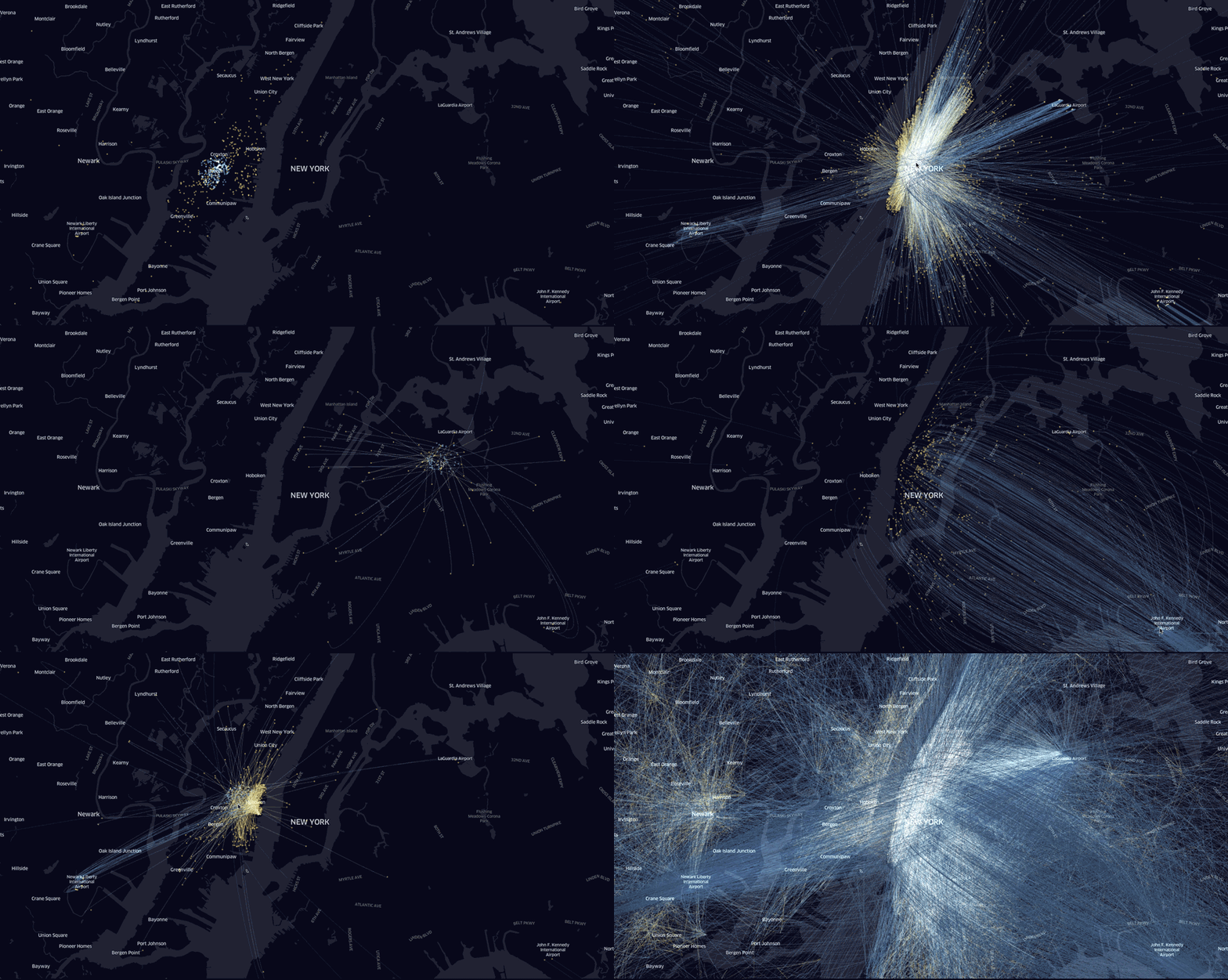
Here is a neat 3D animated map showing a full day of anonymized Uber trips in Los Angeles. You can also read Nicolas Belmonte on how Uber has been using data analytics and visualization in their work at Uber.


Dragging the cursor over a given radius area reveals distributions of Uber dropoffs in real-time. This is pretty cool. I was wondering if someone would be up for the challenge of building a similar interactive map with Shiny in R.

Dragging the cursor over a given radius area reveals distribution dropoffs in real-time.

Thursday, November 19, 2015

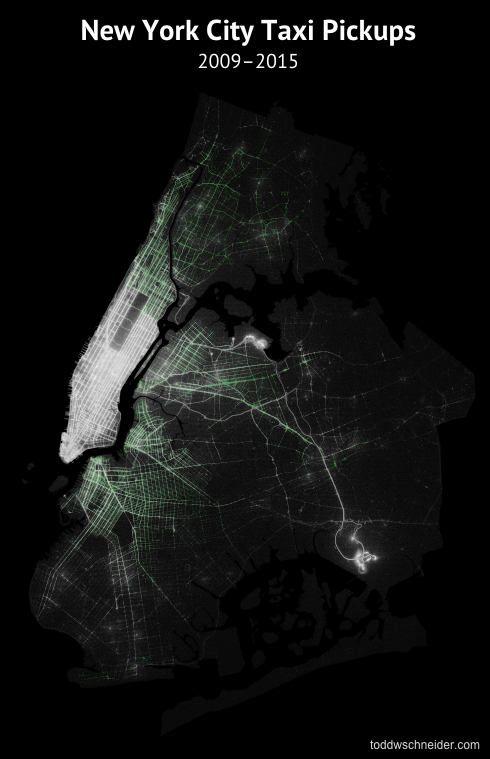
Exploring 1.1 Billion NYC Taxi and Uber Trips


Todd Schneider has posted a thorough analysis of 1.1 Billion NYC Taxi and Uber Trips where he explores the city's neighbourhoods, night-life, airport traffic etc. You can replicated all that using publicly available data, R, PostgreSQL and PostGIS. GitHub repository here.


Tuesday, June 30, 2015

Uber and the Headline of a Newspaper in 2030

 How Uber is gaining the headlines in the year 2015:


... and how things might change in the future.


Monday, November 24, 2014

What a neuroscientist is doing at Uber


Some of San Francisco’s Uber Networks
[image credit: Bradley Voytek]


*By now, you should have heard about Uber. If you haven't, I would recommend you to check this Freakonomics episode where they talk about Uber, what it is, its promises to the future of urban transport and some of its controversies.