Showing posts with label Development. Show all posts

Monday, June 1, 2015

Glaeser on Cities, Development, and Density

The NYU Stern Urbanization Project has been organizing a number of great seminars that cover interesting speakers at the intersection of urban planning and economics (Check their YouTube channel here). In December last year, they had Edward Glaeser talking about Cities, Development, and Density.


In case you want a more academic reference, much of Glaeser's presentation is present in his recent paper on 'the causes and consequences of urbanization in poorer countries'.

Wednesday, May 27, 2015

The Brasilia experiment: Road access and long-term local development in Brazil

Bird, J., & Straub, S. (2014). The Brasilia experiment: road access and the spatial pattern of long-term local development in Brazil. World Bank Policy Research Working Paper, (6964).

Abstract:
This paper studies the impact of the rapid expansion of the Brazilian road network, which occurred from the 1960s to the 2000s, on the growth and spatial allocation of population and economic activity across the country's municipalities. It addresses the problem of endogeneity in infrastructure location by using an original empirical strategy, based on the "historical natural experiment" constituted by the creation of the new federal capital city Brasília in 1960. The results reveal a dual pattern, with improved transport connections increasing concentration of economic activity and population around the main centers in the South of the country, while spurring the emergence of secondary economic centers in the less developed North, in line with predictions in terms of agglomeration economies. Over the period, roads are shown to account for half of pcGDP growth and to spur a significant decrease in spatial inequality.

The first author of this study is Julia Brid, a postdoctoral researcher at the Economics Dept. here at Oxford and whom I had the pleasure to meet the other day. Julia has been working with V. Henderson, T. Venables and P. Collier in a joint LSE/Oxford research project on Urbanisation in Developing Countries. It is an amazing project and I am sure we'll see some of its publications coming out soon.


Monday, January 12, 2015

Assorted links


  1. The Best Satellite Images of 2014

  2. Extrapolating the backgrounds of famous art with machine learning

  3. We've Been Incorrectly Predicting Peak Oil For Over a Century

  4. Forbes Magazine has recently published their list of 30 Under 30 Science, with brightest scientists in 15 different fields under the age of 30. A huge congrats to my Department friend John Mittermeier ! Mom, I told you I'm not on the list! By the way, John has some amazing photos as well

  5. The most detailed tweet map ever, with 6 Billion Tweets (high definition), by Eric Fischer

  6. A great selection of the best Data Visualizations of 2014

  7. The Reversal of the Latitude-Income Correlation

  8. A Fully Interactive Map of the Middle Earth, from The Lord of the Rings

  9. The Modern Beauty of 19th-Century Data Visualizations

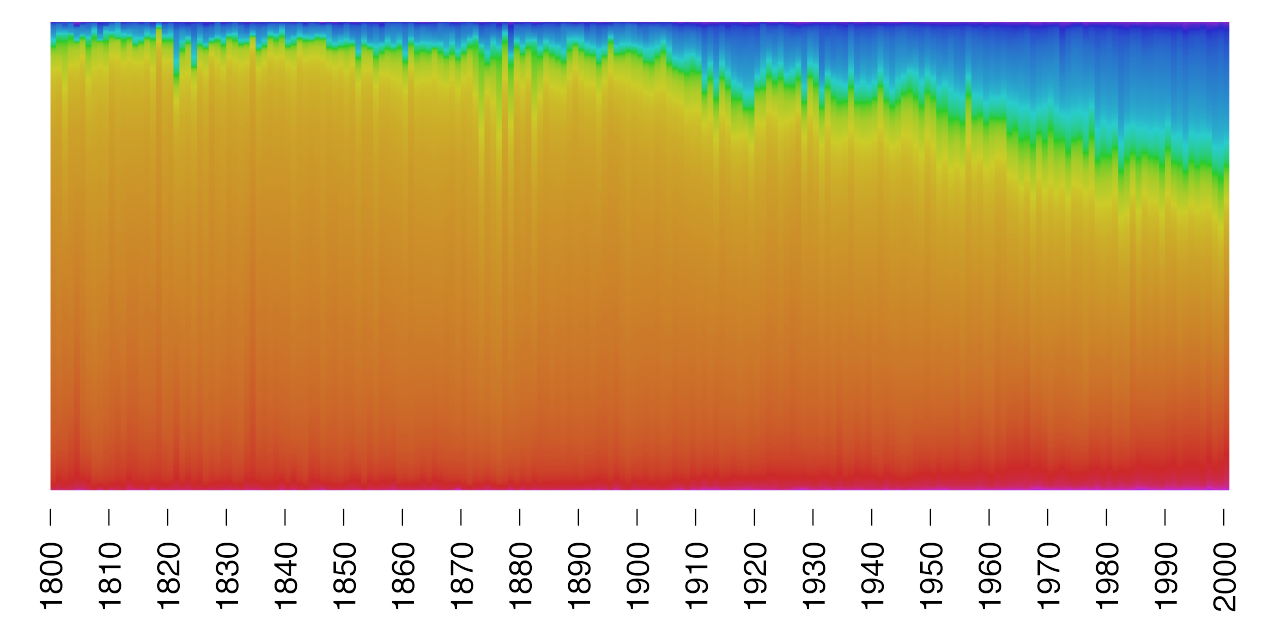
US population composition by place of birth, 1790-1890
[click on the image to enlarge it]
[image credit: 1870s statistical atlas, via Laura Bliss]


Monday, November 4, 2013

Quote of the Day

“Anyone who believes in indefinite growth on a physically finite planet is either mad, or an economist.”

Wednesday, May 29, 2013

The importance of titling and property rights

A 10-minute video from MRUniversity course on development economics covering the theory and empirical research on the importance of titling and property rights (via Alex Tabarrok).

Tuesday, February 5, 2013

The Economic Future of British Cities

Prof Henry Overman (SERC / LSE) gave a very interesting lecture a couple of weeks ago. The lecture was titled 'The Economic Future of British Cities: What should Urban Policy Do?'

He addressed several issues such as migration, housing, skilled workforce, labor productivity and regional wage disparities, to name a few.

You can download both the lecture and the slides here. You may also go further into Overman's writings on SERC blog Part I, Part II.

Tuesday, January 22, 2013

Does aging population hinder Innovation?

Here is the reasoning basis.
Sociologists have described a technology adoption life cycle, which represents the way an invention spreads throughout a community. It’s depicted as a bell curve where the x-axis represents time and the y-axis represents the number of adopters. [...] If the young tend to be more creative and to adopt new ideas more readily than the old, then the coming demographic changes—rising median ages across the West—portend a strong headwind for innovation in the next decades. Not only will we have fewer workers, but we’ll also have fewer inventors and what new ideas we have will face stronger resistance. [...] (by Michael Gibson, Forbes)

It sounds palusbile, although it is not clear yet how deeply innovation levels are affected by demographics. Additionally, I'd say that the coming demographic changes are not likely to affect all levels of innovation (from smartphones and tablets to tomographs and clean energy) in the same way.

So here lies one question: Can current economic and demographic trends around the globe change the geography of innovation markets (both production and consumption) in the future?

Related link:

Monday, November 12, 2012

Poor Economics

I have just finished reading Poor Economics, a book by Abhijit V. Banerjee and Esther Duflo (both professors of Economics at MIT).* It brings into a sharp perspective the complex economic lives of the poor and the failure of some anti-poverty policies. It also brings up several creative studies, including some that have used randomized controlled trials. It's a really good reading! 

There is a website of the book where you can have a glimpse of it and explore interactive charts. Or, you may watch a short presentantion by Esther Duflo:


*Thank you Lucas Mation for the gift!

Monday, October 8, 2012

Charter Cities (and Paul Romer) in 15 min.

Alex Tabarrok summarizes in 15 min. the contribution of Paul Romer to Development Economics and his idea about the Charter Cities.


related link: Honduran charter cities in troubled muddy waters (here and here)

Saturday, May 12, 2012

Viva la Revolución (Industrial !)

Hans Rosling (aka the “Mick Jagger” of TED) in another great presentation. It's worth 9 minutes of your life.

Tuesday, November 30, 2010

Just in case you haven't met him yet

Hans Rosling presenting the last 200 years of world development history (truly ablaze).

(Thanks to flowingdata)

Thursday, September 9, 2010

Demographic factors of China's economic growth


Joel Kotkin published an article suggesting 5 key reasons why China is not likely to become the world's largest economy. It caught my attention the fact that 4 of them are demographic-related in some way.
According to J. Kotkin, China is more likely to face problems such as (1) Scarce water, (2) lack of adequate energy resources and (3) limited food production over the next decades. As I was reading the article, I couldn't help remembering Malthus. In order to sustain economic growth, China will need to face a 4th obstacle: rapidly aging population and shrinking workforce (a clearly demographic problem).
By 2050 31% of China's population will be older than 60. “There will be over 400 million elderly, with virtually no social security and few children to support them”. And Kotkin also calls the attention to:
  1. The preference for male children has skewed sex demographics dramatically, with roughly 30 million more marriageable boys than girls.
  2. The logical solution to this dilemma would be immigration, but China's culture appears far too insular for such an event. Rather than a benevolent "socialist" super power China, whose population is made up over 90% Han Chinese, will bestride the world as a racially homogeneous, and communalistic "Middle Kingdom."

It's funny because usually China demographics are considered an important factor to China's economic growth. Hey! Not that I agree with Joel Kotkin all the time, but it's an interesting article. You can read it here.

ps. The 5th key reason: Chinese political instability on the long run as a result of a combination of authoritarian regime and growing inequality