Interesting article about the commuting patterns in Germany's major metropolitan areas. If you don't read German like myself, use Google Translator.

credit: Paul Blickle for Zeit

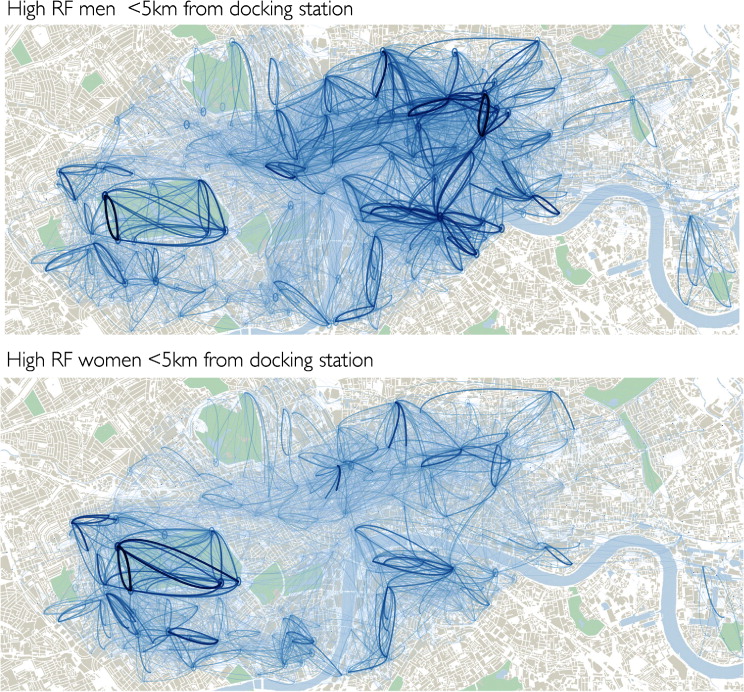
Analysing over 10 million journeys made by members of London's Cycle Hire Scheme, we find that female customers' usage characteristics are demonstrably different from those of male customers. Usage at weekends and within London's parks characterises women's journeys, whereas for men, a commuting function is more clearly identified. Some of these variations are explained by geo-demographic differences and by an atypical period of usage during the first three months after the scheme's launch. Controlling for each of these variables brings some convergence between men and women. However, many differences are preserved. Studying the spatio-temporal context under which journeys are made, we find that women's journeys are highly spatially structured. Even when making utilitarian cycle trips, routes that involve large, multi-lane roads are comparatively rare, and instead female cyclists preferentially select areas of the city associated with slower traffic streets and with cycle routes slightly offset from major roads.
"There is too much #traffic for Billy to walk to school. So we drive him." We can change this. Help spread the word. pic.twitter.com/FC93lCsqmP— Brent Toderian (@BrentToderian) 17 February 2014
Abstract: We estimate that a significant fraction of commuters on the London underground do not travel their optimal route. Consequently, a tube strike (which forced many commuters to experiment with new routes) taught commuters about the existence of superior journeys -- bringing about lasting changes in behaviour. This effect is stronger for commuters who live in areas where the tube map is more distorted, thereby pointing towards the importance of informational imperfections. We argue that the information produced by the strike improved network-efficiency. Search costs are unlikely to explain the suboptimal behaviour. Instead, individuals seem to under-experiment in normal times, as a result of which constraints can be welfare-improving.
The availability of massive digital traces of human whereabouts has offered a series of novel insights on the quantitative patterns characterizing human mobility. In particular, numerous recent studies have lead to an unexpected consensus: the considerable variability in the characteristic travelled distance of individuals coexists with a high degree of predictability of their future locations. Here we shed light on this surprising coexistence by systematically investigating the impact of recurrent mobility on the characteristic distance travelled by individuals. Using both mobile phone and GPS data, we discover the existence of two distinct classes of individuals: returners and explorers. As existing models of human mobility cannot explain the existence of these two classes, we develop more realistic models able to capture the empirical findings. Finally, we show that returners and explorers play a distinct quantifiable role in spreading phenomena and that a correlation exists between their mobility patterns and social interactions.
