- Call for papers - BUFTOD 2012 - Building the urban future and Transit Oriented Development (organized by the Laboratoire Ville Mobilité Transport - LVMT)
- Course - Winter School in Demographic Transition and Developmentat the University of Padova (Italy) - Thanks Joice Vieira for the tip
- Seminar - Population estimates and projections: methodologies, innovations and estimation of target population applied to public policies (organized by ALAP) -Thanks Tirza Aidar for the tip
- Are you looking short term courses or seminars? The Lincoln Institute has just published its annual program for the new academic year 2011-2012.
Thursday, September 29, 2011
Opportunities

My future me
How the dramatically aging demographics in the USA will change over the next 40 years ? And how do you fit into this ? Click here for your answers! "Visualizing Our Future Selves" .


Tuesday, September 27, 2011
off-topic: Suicide Paradox
"There are twice as many suicides in the US each year than murders."
I heard this startling stantement at the Freakonomics Radio. So I decided to write this post for two reasons. First, to recommend this podcast: The Suicide Paradox. It's really informative and depressive funny .
Freakonomics Radio: The Suicide Paradox.
Second, I woud like to recommend a book that I believe to be a masterpiece in Sociology. "Suicide: a study in Sociology" by Émile Durkheim (1858-1917). If you want to understand what Sociology is about and don't have anything else better to do , than you should read this book.
My favorite quote from this book is this one on suicide rate:
It "[...] express the suicidal tendency with which each society is collectively afflicted.... Every society is predisposed to produce a certain number of voluntary deaths." It sounds even better in Portuguese. "Cada sociedade está predisposta a fornecer um contingente determinado de mortes voluntárias"
in time: Greece sees suicide rates on the rise. Durkheim Would Have Predicted That One (by The Global Sociology Blog).
in time: Greece sees suicide rates on the rise. Durkheim Would Have Predicted That One (by The Global Sociology Blog).

soundtrack for this post: Titãs.
Monday, September 26, 2011
Assorted Links
- Meet The Economic Complexity Observatory - a multidisciplinary effort between the Macro Connections group at the MIT Media Lab and the Center for International Development at Harvard University.
- Are you looking for short term courses or seminars? The Lincoln Institute has just published its annual program for the new academic year 2011-2012.
- Excellent piece by Ryan Avent in the NYTimes:One Path to Better Jobs: More Density in Cities (via MR)
- All the papers published since 1997 at the Journal of Public Transportation are now available on line (I'm not sure but almost all articles are written in Portuguese). This journal is promoted by the ANTP - National Public Transportation Association (an NGO in Brazil).
- The 'flight to the suburbs' debate in the US: Stephen Von Worley did a very good job to map the change in population density from 2000 to 2010 (census tract level) - Growth Rings 1 and 2.

[Image Credit: Data Pointed]

Midwest population change, 2000-2010. Chicago upper left, Detroit upper right.
[Image Credit: Data Pointed]
[Image Credit: Data Pointed]
Thursday, September 22, 2011
off-topic: The Author List
Sometimes we find ourselves in delicate situations...

Credit: Jorge Cham/PhD Comics
[Click on the image to enlarge it]
Tuesday, September 20, 2011
off-topic: What does it feel like to fly over planet Earth?
(via Dan Colman from Open Culture)
You migh also like the post "Cities at Night" with some photographs of cities at night taken by astronauts from the International Space Station.
Demographic trends in Brazil
Fabio Giambiagi presents (here) what are the main demographic trends in Brazil over the next few decades. Good news: here is no need to panic.... at least not now. (this post was gently stolen from Leonardo Monasterio)
By the way, I would like to share this excellent chart.
Total Fertility Rate in Brazil, Sweden and England, 1900-2000.

[Click on the chart to enlarge the image]
apud Wong and Carvalho (2006) The rapid process of aging in Brazil: serious challenges for public policies. (portuguese version only).
soundtrack for this post: Caetano.
Monday, September 19, 2011
Population Density Maps
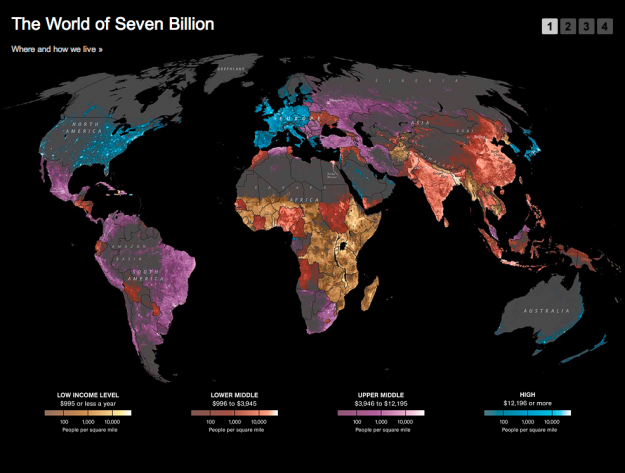
Population density is a basic measure in almost every field - from economy to ecology, biology, urban planning, sociology and, of course, demography! Specialists in Visual Communication are changing the traditional ways to visualize population density.
National Geographic came up recently with this awkward map that combines population densities and average annual gross national income per capita. (via Nathan Yau)

National Geographic came up recently with this awkward map that combines population densities and average annual gross national income per capita. (via Nathan Yau)
I must confess I prefer these density maps designed by Joe Lertola.


Thursday, September 15, 2011
Assorted links on Spatial Segregation
- Great paper on Global and Local Spatial Indices of Urban Segregation (by Feitosa et al. from INPE).
- Schelling's Segregation Model. An Overview of 40 Years of Follow up Studies by Chris Snijders (via jmichaelbatty)
- The 10 most segregated urban areas in the US (via City Block)
#1 - Milwaukee (more here)

[Image Credit: Eric Fisher inspired by Bill Rankin]
Wednesday, September 14, 2011
Demography of Education
For all those Portuguese readers out there, there is this great publication on Demography of Education written by great Brazilian demographers (Introdução à Demografia da Educação).
The Vienna Institute of Demography has also published the a Special Issue on "Education and demography": Vienna Yearbook of Population Research 2010. Memorable contributions:
- Convergence or divergence of educational disparities in mortality and morbidity? The evolution of life expectancy and health expectancy by educational attainment in Austria in 1981-2006 (Johannes Klotz)
- The demography of education in Brazil: inequality of educational opportunities based on Grade Progression Probability (1986-2008) (Eduardo Rios-Neto and Raquel Guimarães)

Subscribe to:
Comments (Atom)