Why do I like tilt-shift time-lapse videos so much? I think it's because these kinds of shots give us a sensation that we could get the big picture of how things work when of course we can't
Saturday, April 27, 2013
Friday, April 26, 2013
Latin American Human Mortality Database
Some of you have probably heard about the Human Mortality Database. Now, Prof. B. Piedad Urdinola (National University of Colombia) and Prof. Bernardo Lanza Queiroz (Cedeplar/UFMG, Brazil) have recently started a new project with a similar idea but covering Latin American countries. It's the Latin American Human Mortality Database.
It brings tons of information and it's really well organized with easy navigation.

"At present the database contains detailed information on mortality for five countries in Latin America: Argentina, Brazil, Colombia, Mexico and Peru. All information is broken down by age, sex, region and cause of death. Additionally there is information on the academic literature on the study of mortality for these same countries."
Long live the project!

Thursday, April 25, 2013

Wednesday, April 24, 2013
Assorted Links
- Sim Paulo - Sao Paulo's transport system modelled in SimCity (by Mike Rose via Drunkeynesian)
- Sociology/Demography Vacancies at Cambridge University
- Brazil’s bottlenecks (via Matheus Stivali)
- Brazilian universities should be considering something similar to this
- 10 strange houses (via C. Blattman)
- Using unusual surnames and other tricks to gauge intergenerational mobility
- Income inequality, as seen from space
- Urbanization and Migration Externalities in China (via UrbaChina)
- What will your last 10 years look like? (better with no sound)
Monday, April 22, 2013
An experimental confirmation of the Spatial Mismatch Hypothesis
Self-recommending: Getting to Work: Experimental Evidence on Job Search and Transportation Costs, by David Phillips.
Abstract:
In urban areas job vacancies often exist but poor, minority residents tend to be concentrated in neighborhoods with limited geographic access to these jobs. Using a randomized field experiment with public transit subsidies, I test whether this spatial mismatch of workers from jobs causes poor labor market outcomes. Randomly selected clients of a non-profit employment agency received a public transit subsidy to assist in applying to jobs and attending interviews with potential employers. I find evidence that the transit subsidies have a large, short-run effect in reducing unemployment durations with treatment causing the probability of finding employment within 40 days to increase by 9 percentage points, from 0.26 to 0.35. After 90 days, this difference narrows to a large but statistically insignificant 5 percentage points. I find weaker evidence that this decrease in unemployment duration results from more intense search behavior, with the transit subsidy group applying to more jobs and jobs further from home. To my knowledge, these results provide the first experimental confirmation that spatial mismatch of workers from jobs can cause adverse labor market outcomes for poor, urban individuals.This study was presented last year at a conference on 'Research on Urban Mass Housing' that took place at Oxford. Nice programme, by the way.
Chart of the Day
obs.1 It's hard to believe Rio de Janeiro would be more polluted than Sao Paulo. I would love to hear a specialist analyze this.
obs2. You may explorer the data here, or navigate a map by clicking here.

obs2. You may explorer the data here, or navigate a map by clicking here.

[Image Credit: The Economist]
Friday, April 19, 2013
12 years in the American housing market

A few months ago, Kevin Quealy has published in the NYT this interactive chart showing the ups and downs in the American housing market over the last 12 years.
Related Links:
Thursday, April 18, 2013

Assorted Links on Workforce and Education
- Trends in the demand for educated labor and the gap between education supply and demand in US metropolitan areas
- The changing demographics of Brazilian workforce [availabe in Portuguese only]
- Female Labor Force Participation in Brazil (via Andres Marroquin)
- Skills deficit holds India back
- A Detailed Look at Workforce Skill Shortages in the US
- OECD Report - Education at a Glance 2012 (via Drunkeynesian)
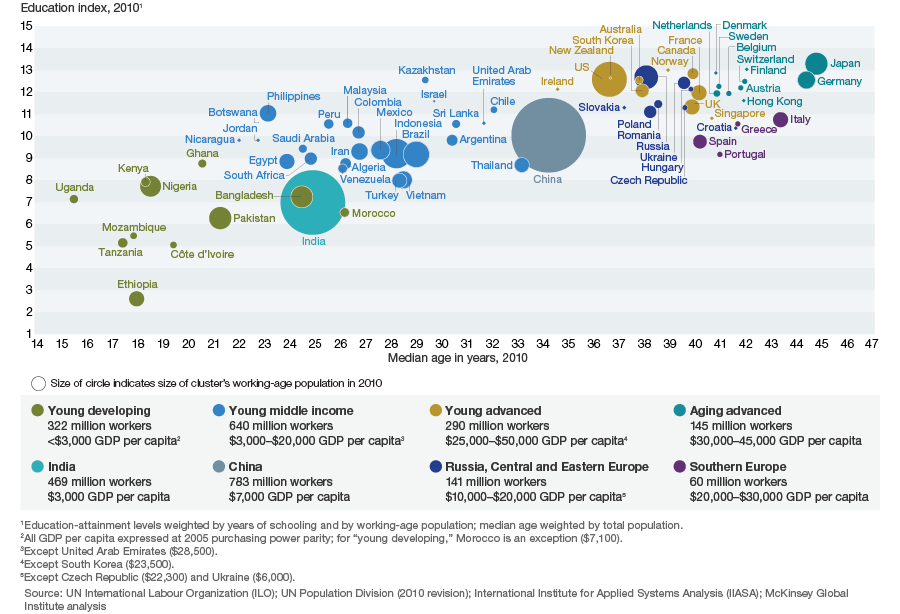
- A new report by McKinsey on Jobs, pay, and skills around the world

Subscribe to:
Posts (Atom)