Wednesday, February 16, 2011

Short interview with Glaeser

A short and funny interview with Glaeser at the Daily Show promoting his new pop book. His conversation with David Leonhardt (economix) is also worth a read.


Tuesday, February 8, 2011

Call for papers (and people) - Updated!

Call for papers:

ISUF 2011 - 18th International Seminar on Urban Form.

Submission Deadline (abstract): 25 February 2011

Spaces and Flows Conference 2011.

Submission Deadline: 24 February 2011


51st European Congress of the Regional Association International
Submission Deadline: 4th of March 2011

Submission Deadline: 21 February 2011


58th Annual North American Meetings of the RSAI / 6th Meeting of the Urban Economics AssociationThe abstract/session submission portal will open in April 2011

World Symposium on Transport and Land Use Research (WSTLUR)
Submission Deadline: December 31, 2010 (Missed that)

XI Jornadas Argentinas de Estudios de Población
Submission Deadline: 15 april 2011


Submission Deadline: 31 January 2010 (Missed that)


Call for people:

European Doctoral School of Demography (EDSD)
Application deadline: 15 April 2011. - [thanks Joice Melo Oliveira]


Several summer courses 2011 at the IMPRSD - International Max Planck Research School for Demography
Application deadline: 31 March 2011 - [thanks Joice Melo Oliveira]


UPDATED: The MIT Portugal Program announces its call for applications for the PhD in Transportation Systems (and Master in Complex Transport Infrastructure Systems).
Applications Deadline: 28 February for the PhD course, and until March 31 for the Master’s Course

The closing date for applications is 10th March 2011.

El Centro de Estudios Demográficos, Urbanos y Ambientales (CEDUA) de El Colegio de México convoca a interesadas e interesados de cualquier nacionalidad al concurso para contratar un profesor-investigador.

Thursday, February 3, 2011

Cities at Night

The NASA Earth Observatory has a huge 'collection' of beautiful photographs. This collection includes some photographs of cities at night taken by astronauts from the International Space Station.

Astronauts circling the Earth have the wonderful vantage point of observing the nighttime Earth from 350-400 kilometers above the surface, taking in whole regions at once. Onboard cameras and a bit of experimentation allow astronauts to take highly detailed images of our cities at night and share them with the rest of us.


Brasília at night is the current image of the week. They say that "Brasília is widely considered to be one of the best examples of 20th century urban planning in the world." I'll try to take that as a complement.


And my favorite ones:

Tokyo Bay at night.

Tuesday, January 25, 2011

São Paulo Urbanization (1957-2007)

Folha.com (what could be considered the equivalent of the New York Times here in Brazil) is publishing special articles on the 457º Anniversary of the City of São Paulo.

The articles are written in Portuguese. But you can enjoy a few images of São Paulo Urbanization here.

Guarapiranga dam

(photo credit: Base Aerofogrametria)


The planned neighborhood of Vila Formosa.
make gif animation
(photo credit: Base Aerofogrametria)

You can visualize other areas here (lazy link).

There is also a "before and after" session with pictures of São Paulo central area.

ps. Happy Birthday São Paulo !

Thursday, January 20, 2011

Counterintuitive trues about urban transport


Enrique Peñalosa (former mayor of Bogotá) presented a pleasant lecture at LSE titled: “Politics, Power, Cities”. Listen to podcast here (approx 91 min).

Here are some interesting snippets (They might look obvious to some of you. But do they look obvious to you mayor?)

  • What creates traffic is not the number of cars, is the number of trips and the length of trips.

  • Mobility and Traffic Jams are total different problems that require different solutions. Reducing car use is different than solving Traffic Jams.

  • To solve Traffic Jams is, in fact, to facilitate car use.

  • The only way to solve Mobility is with public transport. This will solve Mobility but not Traffic Jams.

  • The only way to solve Traffic Jams is restricting car use. And the most obvious way to restrict car us is restrict parking.

  • To park is not a Constitutional right anywhere.

  • For public transport the most important thing is Density.

*ps. I agree with these statements ("counterintuitive trues" as said Peñalosa). And I don't think they contradict the ideia of polycentric cities.

*ps2. He didn't say much (nothing) about land use... I missed that.

Tuesday, January 18, 2011

Assorted links on Chinese Urbanization

  1. Urban China in 30 frames. Here. (via Moving Cities)
  2. The new issue of the Journal of Transport and Land Use (JLUT) focuses on China. Here!

  3. Dan Steinbock on Chinese urbanization and labor force supply. Here.

    excerpt: "The urbanization that took almost a century in the West is occurring in a decade or two in China. In 1979, Shenzhen was still a poor fishing village with some 20,000 inhabitants. In 2009, it had a population of 9 million, and income per capita exceeded $13,600, only $3,000 less than in Taiwan or South Korea."

  4. Lisa Gu on possible urban decentralization in China. Here.
    excerpt: "The shifts in the value of a hokou parallels another interesting shift: many migrant workers are returning to their hometowns much earlier. In the previous years, migrant workers would usually return home right before Lunar Chinese New Year, which typically falls in February, but a large number of them have started to return home in December this year. // The driving factor behind this change is that the cost of living in the cities has risen so dramatically over the past few years, and the money migrant workers earn barely covers their living costs. // Although China’s urbanization will likely continue, the patterns might increasingly be to smaller cities and towns. In this sense, China’s development may, sooner than any expected, begin to take on the dispersion pattern that has occurred in the Western countries for more than a half century.

Thursday, January 13, 2011

The death of Modern Architecture(?)

Is Modern architecture dead?

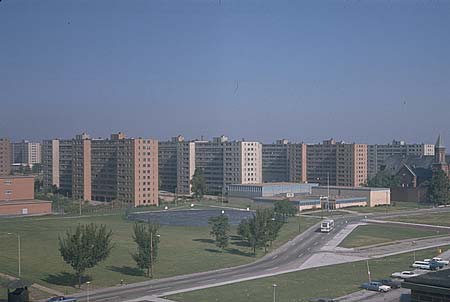
Pratik Mhatre (Urban Planning Blog) posted the trailer for the documentary film "The Pruitt-Igoe Myth: an Urban History" . Here is the Trailler (and the documentary official website):
I didn't know of the existence of Pruitt–Igoe until this post. And now, thanks to wikipedia, I know that Pruitt–Igoe
  • "was a large urban housing project first occupied in 1954 and completed in 1955 in the U.S. city of St. Louis, Missouri".
  • "The complex was designed by architect Minoru Yamasaki, who also designed the World Trade Center towers."
  • Furthermore, "The Pruitt–Igoe housing project was one of the first demolitions of modernist architecture and its destruction was claimed by postmodern architectural historian Charles Jencks to mark 'the day Modern architecture died'."

One particular point caught my attention: Pruitt–Igoe's collapse seems to be attributed exclusively to its modernist architecture. Isn't a too simplistic statement? Brasilia (a remarkable urban experiment) is doing fine so far (?is it?).

What could help us understand the different fates (failure and success) faced by modernist urban planning experiences ? [urban scale? capita income, and other sociodemographic characteristics?....]


These are some photos of Pruitt–Igoe back then.
[photo credit: Legmountain]


[photo credit: Wikipedia]

[photo credit: Wikipedia]


a few photos of Brasilia :


[photo credit: designKULTUR]


[photo credit: Prof. Frederico Holanda]

[photo credit: urbanism.org]

Wednesday, January 12, 2011

Assorted links


[photo by Christoph Gielen]
[photo by Christoph Gielen]

[photo by Christoph Gielen]

Wednesday, January 5, 2011

Wolrd Balance

Ok. Now back to real world!

And talking about the world population, every now and then someone comes up with the overpopulation issue. Usually it is referred to as the "overpopulation problem".


This is the promo motion graphic for the World Population Special Series brought by National Geographic (the article here and some pictures here). I couldn't agree more with these two conclusive excerpts:


"But one can also draw a different conclusion—that fixating on population numbers is not the best way to confront the future. People packed into slums need help, but the problem that needs solving is poverty and lack of infrastructure, not overpopulation. Giving every woman access to family planning services is a good idea—“the one strategy that can make the biggest difference to women’s lives,” Chandra calls it. But the most aggressive population control program imaginable will not save Bangladesh from sea level rise, Rwanda from another genocide, or all of us from our enormous environmental problems."

"The number of people does matter, of course. But how people consume resources matters a lot more. Some of us leave much bigger footprints than others. The central challenge for the future of people and the planet is how to raise more of us out of poverty—the slum dwellers in Delhi, the subsistence farmers in Rwanda—while reducing the impact each of us has on the planet."