Patricio Gonzalez Vivo does an amazing work by Scraping Google Street View depth data and reconstructing it with openFrameworks to buil a digital city. This is the kind of stuff that makes me like the future more than I like the past.
Tuesday, April 29, 2014
Sunday, April 27, 2014

Friday, April 25, 2014
Monkeys and Their Idea of Justice
A couple of years ago, a friend of mine with a peculiar interest in animal behavior suggested me this video about how animals understand the idea of justice and cooperation etc etc.
The video is based on a paper published on the journal Nature by Frans de Waal and Sarah Brosnan in 2003. The full Ted Talk is here and it worths every minute. But if you don't have much time, this is one of the most interesting bits.
As some of you might remember, in my PhD I`m studying some questions around the ideas of justice very closely and one of my efforts will be to build a fruitful dialogue between more philosophical discussions and the literature in transport and urban studies with a focus on transport policies. Of course, discussing justice issues around urban and transport policies is a bit more complicated than the experiment with the monkeys. Hopefully, I`ll post some updates about this topic with more in-depth discussions in the future as my research progressess. Or maybe I should just skip this boring parts.

Wednesday, April 23, 2014
Assorted links
- Oscar Niemeyer and his buildings- Some of them are incredibly beautiful. Most of them are incredibly nonfunctional
- After-tax income in different counties
- Classic album covers in Google Street View – in pictures
- Cesar A. Hidalgo explaning why we don't really have meritocracy (paper)
- Foucault with a Full Head of Hair
- Porn trends in the UK
- What Does the World Eat for Breakfast?
- Fat city: Questioning the relationship between urban sprawl and obesity
- Mapping flows in ArcGIS, by Alasdair Rae

[image credit: Alasdair Rae]
Monday, April 21, 2014
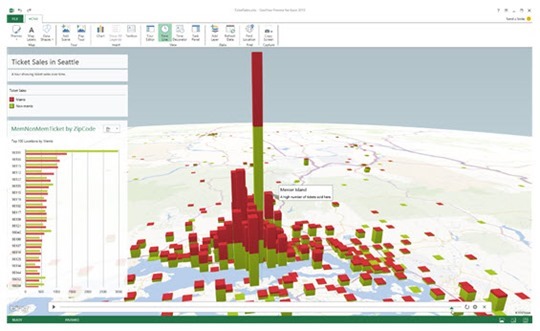
Making 3D Maps in Excel
Yeap! You read it right. Microsoft is chasing the game of geospatial analysis (via Flávia Feitosa).
They have developed an add-in called GeoFlow that enables interactive 3-D geospatial data visualizations in Excel. It looks like a good platform for a wider audience. A preview of GeoFlow is available for download here.

Sunday, April 20, 2014
Your Language structure affect how you act
Chen, M Keith (2013) "The Effect of Language on Economic Behavior: Evidence from Savings Rates, Health Behaviors, and Retirement Assets." American Economic Review, 103(2): 690-731. (unloccked version on Keith's page)
Abstract
Languages differ widely in the ways they partition time. In this paper I test the hypothesis that languages that do not grammatically distinguish between present and future events (what linguists call weak-FTR languages) lead their speakers to take more future-oriented actions. First, I show how this prediction arises naturally when well-documented effects of language on cognition are merged with models of decision making over time. Then, I show that consistent with this hypothesis, speakers of weak-FTR languages save more, hold more retirement wealth, smoke less, are less likely to be obese, and enjoy better long-run health. This is true in every major region of the world and holds even when comparing only demographically similar individuals born and living in the same country. The evidence does not support the most obvious forms of common causation. I discuss implications of these findings for theories of intertemporal choice.
You may watch Chen presenting his study at a TED event here.
Wednesday, April 16, 2014
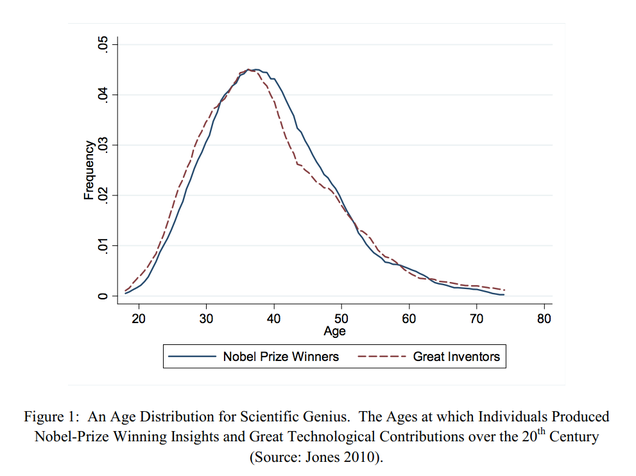
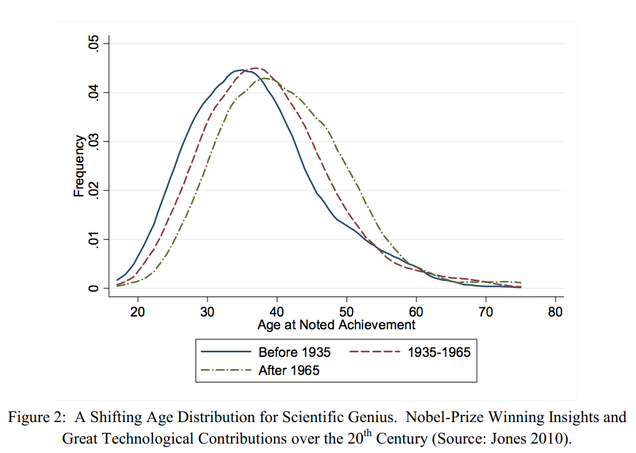
The Age of Peak Academic Performance
An interesting paper on the age of peak academic performance (via Bernardo L Queiroz).
Abstract:

Abstract:
Great scientific output typically peaks in middle age. A classic literature has emphasized comparisons across fields in the age of peak performance. More recent work highlights large underlying variation in age and creativity patterns, where the average age of great scientific contributions has risen substantially since the early 20th Century and some scientists make pioneering contributions much earlier or later in their life-cycle than others. We review these literatures and show how the nexus between age and great scientific insight can inform the nature of creativity, the mechanisms of scientific progress, and the design of institutions that support scientists, while providing further insights about the implications of aging populations, education policies, and economic growth.
[click on the image to enlarge it]
Tuesday, April 15, 2014

Friday, April 11, 2014
Assorted links
- PhD Scholarships for students in Latin America, by the Lincoln Institute of Land Policy
- 100 historic photographs of Brazil
- Watch Water Boil And Freeze At The Same Time Read (via Mariana Rossi)
- What happens when governments try to help poor people move to better neighborhoods?
- A 3200 year old tree, possibly the biggest tree on Earth
- African Bus Routes Redrawn Using Cell-Phone Data
- A short video dedicated to my friends with obsessive compulsive disorder
- The first-ever asteroid with rings has recently been discovered. A nice video and the paper.
- 40 years of Chicago's rising inequality, in one GIF via Demografía_CSIC

Wednesday, April 9, 2014
Rise in Transport Costs in Brazil
In June 2013, the rise in Bus fares were the spark for huge protests in more than 80 cities in Brazil. In this report (published in Portuguese last year) we analyze some of the main pricing and funding issues of public transport in Brazil. The rise in transport costs in the country is just of them, and in which govermental policies have played an important role subsidizing gasoline consumption and the purchase of new cars.
For more details and a further discussion on this issue, you may read the report here.
For more details and a further discussion on this issue, you may read the report here.
And for now, here are some figures and a chart showing the increase in inflation and its transport components between 2000 and 2012 for the largest Brazilian metropolitan areas.
IPCA (Inflation): 125%
Bus fares: 192%
Gasoline: 122%
Owning a vehicle: 44%

Label Translation:
[click on the image to enlarge it]
- IPCA = consumer price index
- Tarifa de ônibus = Bus fare
- Tarifa de Metro = Subway fare
- Gasolia = Gasoline
- Veículo próprio = Owning a vehicle (car or motocycle), including purchase and maintenance expenses.
Subscribe to:
Posts (Atom)