
Showing posts with label gender. Show all posts
Showing posts with label gender. Show all posts
Monday, March 12, 2018
Saturday, December 9, 2017
Assorted Links
-
-
-
-
-
- Alex Singleton, Seth Spielman and David Folch have a new book called Urban Analytics. The book looks really promising! I haven't had the chance to read it
need to work on my phd thesisand it is packed with GitHub resources that you can access here -
-
- The transition from more than 6 to fewer than 3 children per woman took the UK almost a century. This change took 26 years to happen in Brazil, and only 11 years in China - Max Roser (ht Leo Monasterio)


Thursday, July 6, 2017
Bicycles empower women: evidence from a quasi-experiment in India
In 1896, the American civil rights leader Susan B Anthony wrote about the crucial role that the bicycle had in women's emancipation and independence. Gradually, more and more evidence shows she was right.
Four years ago we posted about a study by K. Muralidharan and N. Prakash, who analyzed an Indian program "... aimed to reduce the gender gap in secondary school enrolment by providing girls who continued to secondary school with a bicycle that would improve access to school". They have found that the program was an extremely cost-effective way to increase girls’ access to secondary schools and enrolment rates. Their paper just came out published in the American Economic Journal: Applied Economics. (ungated older version here).
Muralidharan, K., and Prakash, N.. 2017. "Cycling to School: Increasing Secondary School Enrollment for Girls in India." American Economic Journal: Applied Economics, 9(3): 321-50.
Abstract
We study the impact of an innovative program in the Indian state of Bihar that aimed to reduce the gender gap in secondary school enrollment by providing girls who continued to secondary school with a bicycle that would improve access to school. Using data from a large representative household survey, we employ a triple difference approach (using boys and the neighboring state of Jharkhand as comparison groups) and find that being in a cohort that was exposed to the Cycle program increased girls' age-appropriate enrollment in secondary school by 32 percent and reduced the corresponding gender gap by 40 percent. We also find an 18 percent increase in the number of girls who appear for the high-stakes secondary school certificate exam, and a 12 percent increase in the number of girls who pass it. Parametric and non-parametric decompositions of the triple- difference estimate as a function of distance to the nearest secondary school show that the increases in enrollment mostly took place in villages that were further away from a secondary school [> 3km], suggesting that the mechanism of impact was the reduction in the time and safety cost of school attendance made possible by the bicycle. We also find that the Cycle program was much more cost effective at increasing girls' secondary school enrollment than comparable conditional cash transfer programs in South Asia.
Friday, March 17, 2017
Chart of the Day: the gender gap in science
Elsevier has recently published the report "Gender in the Global Research Landscape", in which they analyze 'research performance through a gender lens across 20 years, 12 geographies, and 27 subject areas'. The team at The Economist wrote a short summary of the report, showing this chart.
Thanks Claudio Ferraz for the pointer on twitter.

Sunday, November 27, 2016
Cycling infrastructure and gender
A few days ago, I share a paper by Roger Beecham (Twitter) exploring gendered cycling behaviors in London. The paper brings a very interesting descriptive analysis of over 10 million journeys made by members of London's Cycle Hire Scheme.
A recent study by Rachel Aldred (Twitter) and colleagues sheds some more light on this debate with a review paper on how infrastructure preferences vary by gender and by age.
Aldred, R., Elliott, B., Woodcock, J., & Goodman, A. (2016). Cycling provision separated from motor traffic: a systematic review exploring whether stated preferences vary by gender and age. Transport Reviews, 1-27.
Abstract
A recent study by Rachel Aldred (Twitter) and colleagues sheds some more light on this debate with a review paper on how infrastructure preferences vary by gender and by age.
Aldred, R., Elliott, B., Woodcock, J., & Goodman, A. (2016). Cycling provision separated from motor traffic: a systematic review exploring whether stated preferences vary by gender and age. Transport Reviews, 1-27.
Abstract
In this paper, we represent a systematic review of stated preference studies examining the extent to which cycle infrastructure preferences vary by gender and by age. A search of online, English-language academic and policy literature was followed by a three-stage screening process to identify relevant studies. We found 54 studies that investigated whether preferences for cycle infrastructure varied by gender and/or by age. Forty-four of these studies considered the extent of separation from motor traffic. The remainder of the studies covered diverse topics, including preferred winter maintenance methods and attitudes to cycle track lighting. We found that women reported stronger preferences than men for greater separation from motor traffic. There was weaker evidence of stronger preferences among older people. Differences in preferences were quantitative rather than qualitative; that is, preferences for separated infrastructure were stronger in some groups than in others, but no group preferred integration with motor traffic. Thus, in low-cycling countries seeking to increase cycling, this evidence suggests focusing on the stronger preferences of under-represented groups as a necessary element of universal design for cycling.
Thursday, November 17, 2016
Exploring gendered cycling behaviors in London
Beecham, R., &; Wood, J. (2014). Exploring gendered cycling behaviours within a large-scale behavioural data-set. Transportation Planning and Technology, 37(1), 83-97.
Abstract
Abstract
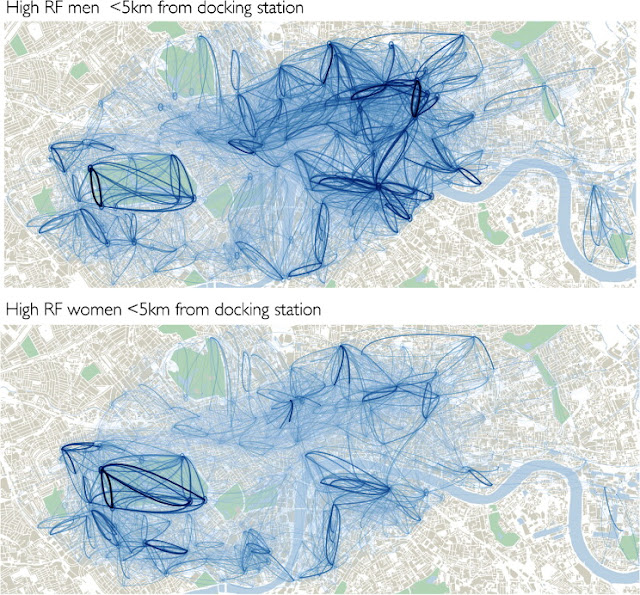
Analysing over 10 million journeys made by members of London's Cycle Hire Scheme, we find that female customers' usage characteristics are demonstrably different from those of male customers. Usage at weekends and within London's parks characterises women's journeys, whereas for men, a commuting function is more clearly identified. Some of these variations are explained by geo-demographic differences and by an atypical period of usage during the first three months after the scheme's launch. Controlling for each of these variables brings some convergence between men and women. However, many differences are preserved. Studying the spatio-temporal context under which journeys are made, we find that women's journeys are highly spatially structured. Even when making utilitarian cycle trips, routes that involve large, multi-lane roads are comparatively rare, and instead female cyclists preferentially select areas of the city associated with slower traffic streets and with cycle routes slightly offset from major roads.
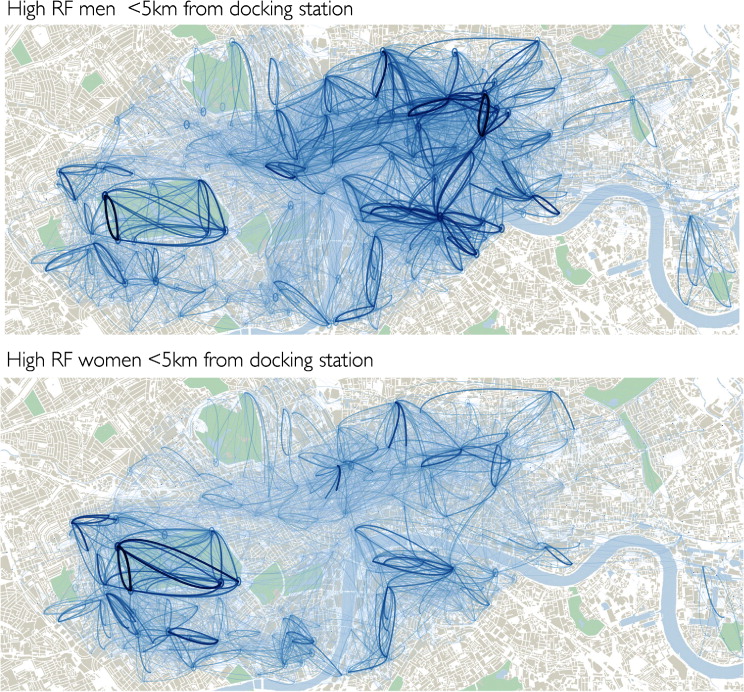
credit: Beecham & Wood (2014)
ps. Interesting paper. I'm not sure what exactly the authors mean by "utilitarian cycle trips", though. I would like to see a more in depth discussion on the root causes of travel behavior differences by gender. It's a great work, though and the authors have a another paper where they focus on the methodology they've used.
Tuesday, May 17, 2016
Assorted Links
- Who's downloading pirated papers? Everyone
- How Uber engineers an efficient route, via Renato Arbex
- Nairobi's first geo-coded accident dataset
- Higher Gender Wage Gap is associated with higher Domestic Violence rates
- Ten tips for Portuguese speakers writing scientific research papers in English (Carl Schmertmann)
- book: Modeling Cities and Regions as Complex Systems: From Theory to Planning Applications
- In case you would like to buy me a gift. Just saying...
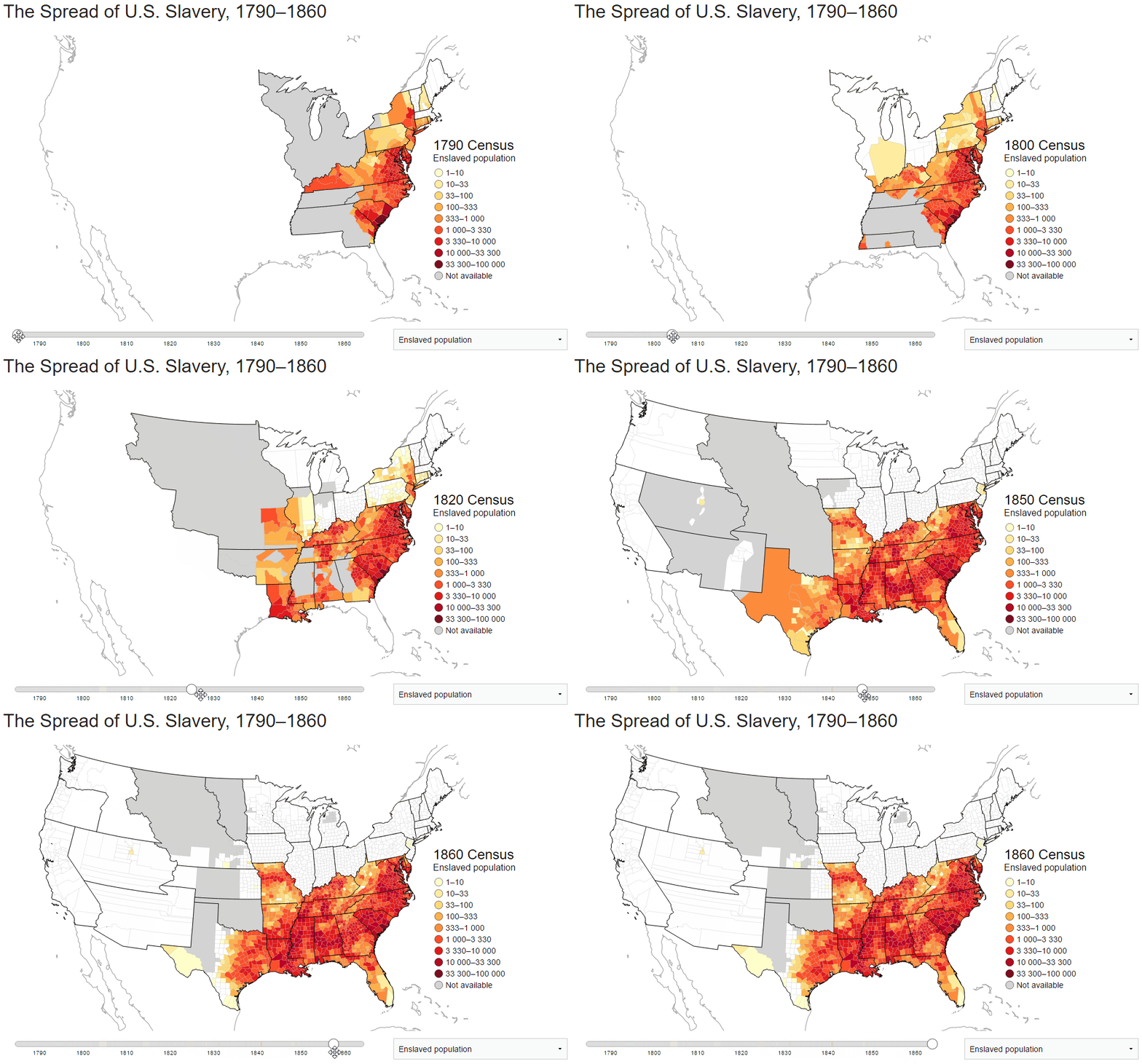
- The Spread of US Slavery (1790 – 1860) and Bill Rankin's version of that map
Monday, May 2, 2016
Assorted Links
- Night lights and regional income inequality in Africa
- Will autonomous vehicles really be safer than conventional cars? Here is why answering this question is not so simple via Tyler Cowen
- Real-time visualization of Ebola evolution and geographic spread
- Higher Gender Wage Gap is associated with higher Domestic Violence rates
- The Global Metro Monitor 2014
- Some Beautiful Abandoned Places In Europe
- How Americans Get to Work, neat interactive dataviz by Nathan Yau
- Nice tool for comparing the size of countries, ht Pablo Astudillo
- A terrific visual and interactive explanation of Gridlock vs. Bottlenecks, by Lewis Lehe

Subscribe to:
Posts (Atom)