Showing posts with label Rio de Janeiro. Show all posts

Thursday, November 7, 2019

New paper out: Distributional effects of transport policies on inequalities in access to opportunities

Glad to share our paper on "Distributional effects of transport policies on inequalities in access to opportunities in Rio de Janeiro" is now out the Journal of Transport and Land Use. I summarize the paper findings and contributions in this short thread here, but please feel free to read the full paper. The journal is open access!


Pereira, R. H. M., Banister, D., Schwanen, T., & Wessel, N. (2019). Distributional effects of transport policies on inequalities in access to opportunities in Rio de Janeiro. Journal of Transport and Land Use, 12(1). doi:10.5198/jtlu.2019.1523

Abstract:
The evaluation of social impacts of transport policies has been attracting growing attention in recent years. Yet studies thus far have predominately focused on developed countries and overlooked whether equity assessment of transport projects is sensitive to the modifiable areal unit problem (MAUP). This paper investigates how investments in public transport can reshape socio-spatial inequalities in access to opportunities, and it examines how MAUP can influence the distributional effects of transport project evaluations. The study looks at Rio de Janeiro (Brazil) and the transformations carried out in the city in preparation for the 2014 World Cup and the 2016 Olympics, which involved substantial expansion in public transport infrastructure followed by cuts in service levels. The paper uses before-and-after comparison of Rio's transport network (2014-2017) and quasi-counterfactual analysis to examine how those policies affect access to schools and jobs for different income groups and whether the results are robust when the data is analyzed at different spatial scales and zoning schemes. Results show that subsequent cuts in service levels have offset the accessibility benefits of transport investments in a way that particularly penalizes the poor, and that those investments alone would still have generated larger accessibility gains for higher-income groups. These findings suggest that, contrary to Brazil’s official discourse of transport legacy, recent policies in Rio have exacerbated rather than reduced socio-spatial inequalities in access to opportunities. The study also shows that MAUP can influence the equity assessment of transport projects, suggesting that this issue should be addressed in future research.

Thursday, July 4, 2019

The winners and losers of the transport legacy of megaevents

Summarizing the core elements of one's research to communicate with a wide audience is among the most challenging and yet important aspects of what researchers do. Here's my best attempt so far to summarize my PhD research to a broad audience, published in my favorite online newspaper Nexo. The text is in Portuguese.

image credit: Nexo

Wednesday, May 29, 2019

My presentation at the 2019 ITF Summit

shameless self-promotion post  again 


Last week I was attending the 2019 International Transport Forum Summit, where I presented a paper on estimating the future accessibility impacts of transport project scenarios. The study also discusses the equity implications of travel-time threshold choice in cumulative opportunity metrics. Such a sexy topic, ah.

My presentation was recorded and you can watch it here (in case you really need to procrastinate on the work you should be doing now).


Saturday, May 18, 2019

Biographical note: ITF/OECD award


Hi all. I am so glad to share that I have been honored with the 2019 Young Researcher of the Year Award, by the International Transport Forum (ITF/OECD). As I've said many times, this award speaks volumes about the generous guidance and support I have received from supervisors and colleagues at both Oxford and Ipea to conduct my research. Special thanks to my incredibly  demanding  supportive supervisors Tim Schwanen and David Banister. Thanks!

This is the award-winning paper, where I investigate the future impacts that different scenarios of a major BRT in Rio de Janeiro could have on access to employment opportunities for different income groups. The study also shows that the the equity assessment of transport projects based on accessibility estimates using cumulative opportunity measures with a single time threshold (the most common practice adopted by academic studies and transport agencies) can lead to misleading or partial conclusions. The preprint of the study is available for download here (it includes a spatial regression analysis that didn't make it into the paper because or reviewer #2).

Thanks to the award, I'll be attending the 2019 International Transport Forum Summit in Leipzig next week. The team at ITF will be Twitting about the Summit. I'll be presenting the paper on May 23rd at  5:15pm (local time). Apparently, it will be webcasted on Facebook Live.

Thursday, April 11, 2019

Biographical note: AAG PhD thesis award

I am very pleased to share that my PhD thesis was awarded the best 2019 thesis award by the Transportation Geography Specialty Group of the American Association of Geographers (AAG). I am also very honoured that I was nominated a board member of the specialty group. If it could be of interest, my thesis is available for download here and I've created a GitHub repository with the R code used in the data wrangling, mapping and analysis in the thesis. Some of the chapters in the dissertation have been published as papers here, here and here (+ this other one currently under review).

I am very grateful for the the support from my partner Fabiana, from the Institute for Applied Economic Research (Ipea) and to the invaluable guidance from my  demanding  tireless supervisors Tim Schwanen and David Banister. 

ps. the blog has been less active than usual in the past weeks because I was away attending the AAG annual meeting to receive the award and to present this paper here.

Thursday, January 31, 2019

Travel time to closest healthcare facility in Rio de Janeiro

The map shows how long it takes (in minutes) to travel by public transport and walking to the closest healthcare facility across the city of Rio de Janeiro. The analysis is disaggregated for facilities providing low-, medium- and high-complexity services. 

The first thing to note here is that physical accessibility to public health is relatively high in Rio. Approximately 94% of Rio`s population could reach at least one facility providing low-complexity services under 30 minutes. Under the same time, medium- and high-complexity services could be reached by 81% and 72% of the population, respectively. This is explained to some extent by the spatial planning of healthcare in the region, which has been relatively successful in spreading low- and medium-complexity facilities across the city. The map also gives a good sense of how the distribution of healthcare facilities vis-à-vis the public transport network varies across space, and how access to public health tend to be much lower in the west and particularly in the urban fringes of the city.

ps. This is a map I created for my PhD research but I didn't include it in the thesis in the end . To create this map I used a 2015 dataset of healthcare facilities and the GTFS of Rio's public transport network from March 2017. The dataviz and data wrangling were done in R. In case you're interested in doing similar analyses, I've created a simple tutorial with reproducible example on how to use OpenTripPlanner (OTP) to estimate travel times.

[click on the image to enlarge it]

Wednesday, January 9, 2019

New paper out: Future accessibility impacts of transport policy scenarios: equity and sensitivity to travel time thresholds


I'm glad to share that the 3rd paper of my thesis is now published. The study (1) illustrates how one can measure the future accessibility impacts of transport project scenarios; (2) discusses how accessibility analyses can be influenced by the little-known issue of the modifiable temporal unit problem (MTUP); and (3) shows that equity assessments of transport policies based on cumulative opportunity metrics depend on the time threshold chosen for accessibility analysis. One thing in particular I like about this paper is that its findings demonstrate that the most common practice adopted by academic studies and transport agencies when evaluating the accessibility impacts of transportation projects can lead to misleading or partial conclusions if this methodological choice is made uncritically.

The paper will remain open access for the next 40 days or so. Downloaded it here [ungated preprint]. The R scripts used to write this paper and my PhD thesis are available in this GitHub repo.


Abstract: 
The accessibility impacts of transport projects ex-post implementation are generally evaluated using cumulative opportunity measures based on a single travel time threshold. Fewer studies have explored how accessibility appraisal of transport plans can be used to evaluate policy scenarios and their impacts for different social groups or examined whether the results of project appraisals are sensitive to the time threshold of choice. This paper analyzes how different scenarios of full and partial implementation of the TransBrasil BRT project in Rio de Janeiro (Brazil) will likely impact the number of jobs accessible to the population of different income levels. The analysis is conducted under various travel time thresholds of 30, 60, 90 and 120 min to test whether the results are sensitive to the boundary effect of the modifiable temporal unit problem (MTUP). Compared to a partial operation scenario, the full implementation of TransBrasil that extends this corridor into the city center would lead to higher accessibility gains due to network effects of connecting this BRT to other transport modes. Nonetheless, the size of the accessibility impacts of the proposed BRT as well as its distribution across income classes would significantly change depending on the time threshold chosen for the accessibility analysis. Considering cut-off times of 30 or 60 min, both scenarios of TransBrasil would lead to higher accessibility impacts in general and particularly for low-income groups, moving Rio towards a more equitable transportation system. However, under longer thresholds of 90 and 120 min, an evaluation of this project would find much smaller accessibility gains more evenly distributed by income levels. The paper highlights how time threshold choice in cumulative opportunity measures can have important but overlooked implications for policy evaluation and it calls for further research on the MTUP in future transport and mobility studies.

Wednesday, November 14, 2018

PhD thesis officially deposited and available for download

PhD thesis officially deposited! You can download the thesis here and check the R code I used in the data wrangling, mapping and analysis in this GitHub repo.*

ps. Special thanks to my friend Christine Moore for making the deposit.


* If you find any mistakes, let me know and I'll try to find someone to blame for.

Saturday, September 8, 2018

Presenting a seminar at UCL on Sept 17th: Distributive Justice and Transportation Equity: Inequality in accessibility in Rio

Hi all. I will be in the UK over the next couple of weeks. My PhD defence is on Sept 18th  but I'm too nervous to talk about it these days . Wish me luck !

For those around London, I'll be presenting part of my doctoral research at UCL on Sept 17th (details below). This is part of a new seminar series on Transport and Social Equity jointly organized by the UCL research networks on socially just transport and planning. Thanks Beatriz Mella and Robin Hickman for the kind invitation.

[click on the image to enlarge it]


Friday, August 31, 2018

New paper out: Transport legacy of mega-events and the redistribution of accessibility to urban destinations


I'm glad to share that the 2nd paper of my thesis is now published. It will remain open access for the next 50 days. Downloaded it here.

This is the 1st empirical paper of my doctoral research. Two other empirical papers are currently under review, but you can read their preprints here and here. My theoretical paper is available here, in case you are looking to have some fun over the weekend.

Pereira, R. H. M. (2018). Transport legacy of mega-events and the redistribution of accessibility to urban destinations. Cities, 81, 45–60. doi:10.1016/j.cities.2018.03.013

Abstract:
Local governments increasingly justify the hosting of mega-events because of their legacy value, assuming that all local residents benefit from those events. Yet, little attention has been paid to the distributive question of who benefits from the transport legacy left by those events. This paper reflects on the delimitation of transport legacies and its social impacts in terms of how such developments can reshape urban accessibility to opportunities. It analyses the transformation in the transport system of Rio de Janeiro (Brazil) in preparation for the 2014 World Cup and the 2016 Olympic Games. That transformation involved substantial expansion in public transport infrastructure, followed by cuts in service levels and a reorganization of many bus lines to streamline the transport system. The paper examines whether those recent changes have increased the number of people from different income levels who could access Olympic sports venues and healthcare facilities by public transport within 15, 30, 60 and 90 min. The analysis uses a before-and-after comparison of Rio's transport network (2014–2017) and a quasi-counterfactual scenario to separate the effects of newly added infrastructure from the reorganization and cuts of transport services. The results show that the infrastructure expansion alone would have increased the number of people who could access the Olympic sports venues, but it would have only marginally improved people's access to healthcare facilities. Nonetheless, the findings indicate that the streamlined bus system have offset the benefits of infrastructure investments in a way that particularly penalizes the poor. The analysis of both the implemented changes to the public transport network and the counterfactual scenario show that the accessibility benefits from the recent cycle of investments and disinvestments in Rio generally accrued to middle- and higher-income groups, reinforcing existing patterns of urban inequality.

Tuesday, May 15, 2018

Urban Picture

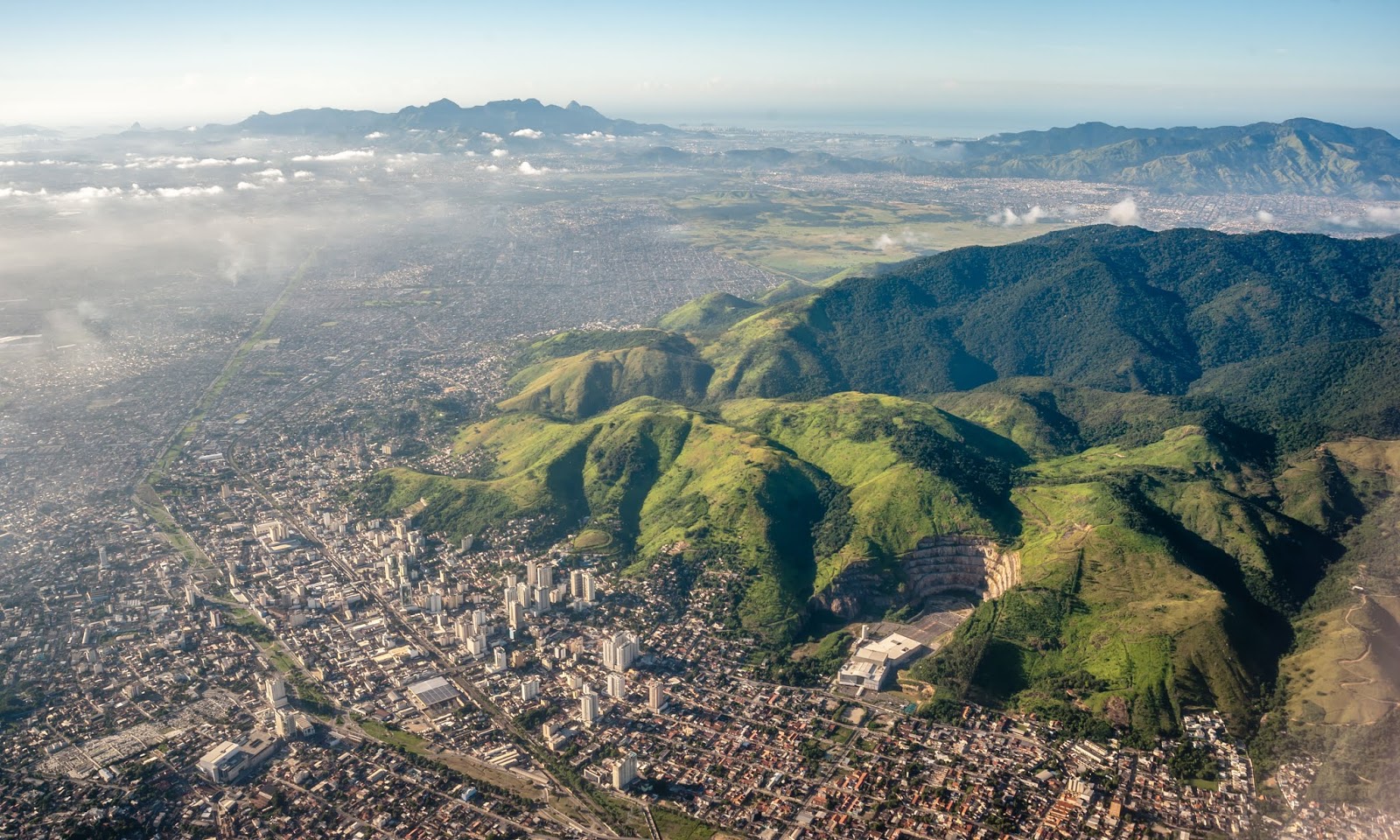
Nova Iguaçu (Brazil). Nova Iguaçu is a municipality in the Metropolitan Area of Rio de Janeiro. The ocean and some of Rio's mountains can be seen in the background of the picture.


source: vonsenke on reddit, HT Vitor Gabriel

Thursday, April 19, 2018

Ex-ante evaluation of the accessibility impacts of transport policy scenarios: equity assessment of BRT expansion

About a month ago, I submitted the 4th paper of my PhD research for publication. The preprint of the paper is available at Open Science Framework (OSF), and you can download it here. Please feel free to read and cite share the manuscript. Suggestions and  criticisms  nice comments are always welcome.

Pereira, R. H. (2018). Ex-ante evaluation of the accessibility impacts of transport policy scenarios: equity and sensitivity to travel time thresholds for Bus Rapid Transit expansion in Rio de Janeiro. OSF Preprints http://doi.org/10.17605/OSF.IO/SUT7R

Abstract:
The accessibility impacts of transport projects ex-post implementation are generally evaluated using cumulative opportunity measures based on a single travel time threshold. Fewer studies have explored how ex-ante accessibility appraisal of transport plans can be used to evaluate policy scenarios and their impacts for different social groups or examined whether the results of project appraisals are sensitive to the time threshold of choice. This paper analyzes how different scenarios of full and partial implementation of the TransBrasil BRT project in Rio de Janeiro (Brazil) will likely impact the number of jobs accessible to the population of different income levels under various travel time thresholds of 30, 60, 90 and 120 minutes. Compared to a partial operation scenario, the full implementation of TransBrasil that extends this corridor into the city center would lead to higher accessibility gains due to network effects of connecting this BRT to other transport modes. Nonetheless, the size of the accessibility impacts of the proposed BRT as well as its distribution across income classes would significantly change depending on the time threshold chosen for the accessibility analysis. Considering cut-off times of 30 or 60 minutes, both scenarios of TransBrasil would lead to higher accessibility impacts in general and particularly for low-income groups, moving Rio towards a more equitable transportation system. However, under longer thresholds of 90 and 120 minutes, an evaluation of this project would find much smaller accessibility gains more evenly distributed by income levels. The paper highlights how time threshold choice in cumulative opportunity measures can have important but overlooked implications for policy evaluation.

Some of the core findings of the paper mentioned in the abstract are illustrated in the figure below. The figure brings box plots that show the distribution of gains in job accessibility via public transport by income groups under partial and full operation scenarios of the TransBrasil BRT project in Rio de Janeiro. The results are shown separately given different choices of travel time thresholds in the accessibility analysis.


Monday, March 26, 2018

Transport legacy of mega-events and the redistribution of accessibility to urban destinations

Good news! The 2nd paper of my thesis is coming out of the oven \o/ . The paper has not been assigned to a journal issue yet, but here you go (pdf).

The paper engages with the literature on mega-events and urban development to understand the particularities of transport planning in Rio de Janeiro, conducted for almost two decades under a context of mega-events planning. It is argued in the study that evaluations of the impacts of mega-events on urban infrastructure should take into account the distributional effects of the transport legacies created by those events, looking particularly at how such transport developments reshape social and spatial inequalities in access to opportunities.

This is the first empirical paper of my thesis. Two other empirical papers are currently under review, but you can read their preprints here and here. My theoretical paper is available here, in case you are interested  or have sleeping problems .


Pereira, R. H. M. (2018). Transport legacy of mega-events and the redistribution of accessibility to urban destinations. Cities. doi:10.1016/j.cities.2018.03.013

Abstract:
Local governments increasingly justify the hosting of mega-events because of their legacy value, assuming that all local residents benefit from those events. Yet, little attention has been paid to the distributive question of who benefits from the transport legacy left by those events. This paper reflects on the delimitation of transport legacies and its social impacts in terms of how such developments can reshape urban accessibility to opportunities. It analyses the transformation in the transport system of Rio de Janeiro (Brazil) in preparation for the 2014 World Cup and the 2016 Olympic Games. That transformation involved substantial expansion in public transport infrastructure, followed by cuts in service levels and a reorganization of many bus lines to streamline the transport system. The paper examines whether those recent changes have increased the number of people from different income levels who could access Olympic sports venues and healthcare facilities by public transport within 15, 30, 60 and 90 min. The analysis uses a before-and-after comparison of Rio's transport network (2014–2017) and a quasi-counterfactual scenario to separate the effects of newly added infrastructure from the reorganization and cuts of transport services. The results show that the infrastructure expansion alone would have increased the number of people who could access the Olympic sports venues, but it would have only marginally improved people's access to healthcare facilities. Nonetheless, the findings indicate that the streamlined bus system have offset the benefits of infrastructure investments in a way that particularly penalizes the poor. The analysis of both the implemented changes to the public transport network and the counterfactual scenario show that the accessibility benefits from the recent cycle of investments and disinvestments in Rio generally accrued to middle- and higher-income groups, reinforcing existing patterns of urban inequality.

Saturday, March 24, 2018

Urban Picture

Morro da Providência favela, the first favela in Brazil, reflected on a new corporate building in the old port area of Rio de Janeiro.


Soundtrack:

Tuesday, November 21, 2017

[follow up] Transport legacy of mega-events, equity and the future of public transport in Rio de Janeiro

A couple of weeks ago, I organized the seminar "Transport legacy of mega-events, equity and the future of public transport in Rio de Janeiro", which was held at the Institute for Applied Economic Research (Ipea) in Rio de Janeiro. The seminar generated some interesting discussions on issues of equity, transport planning and uneven urban development in Rio. It also contributed in bringing together academic researchers, organizations from the civil society and policy makers directly involved with the transport and urban planning of Rio in different governmental levels (municipality and metropolitan area).

The seminar was recorded and the videos are now available on Ipea's Youtube channel. Apart from session 2, all presentations were in Portuguese.

  • In this session, three speakers including myself presented some of their recent work assessing the equity impacts of transport legacy of mega-events in Rio de Janeiro.


  • While the presentations in the 1st session focused on the role of governmental policies in delivering just transport policies and investments, the second session emphasized the role of community organization and self-management in promoting more just and inclusive transport systems despite of the government.


  • In the the third session, academics and policy makers heavily involved in the transport planning of Rio municipality and metropolitan area reflected about some of the issues addressed in the previous sessions and the challenged involved in the transport planning of Rio.

The event gathering a good audience (aprox. 70 people) and it received attention from national and local TV channels and newspapers. If you don't have time to watch the entire seminar, these four pieces give a good summary of the discussions:
  1. Rio on Watch: "The Results Are In: Costly Mega-Event Transport Projects Did Not Expand Mobility, Address Inequalities"
  2. Rio on Watch: "Experts Debate the Future of Transport in Rio’s Metropolitan Region"
  3. [Portuguese] G1: "Obras viárias da Copa e Olimpíada contribuíram pouco para melhoria do transporte do Rio, aponta Ipea"
  4. [Portuguese] O Globo: "Obras de mobilidade urbana para Copa e Olimpíada favoreceram mais parcela rica da população do Rio"


Monday, October 30, 2017

Transport legacy of mega-events, equity and the future of public transport in Rio de Janeiro

Just a quick update of my PhD.

A few months ago I was awarded the Lee Schipper Memorial Scholarship, by the WRI Ross Center for Sustainable Cities. This award was established in 2012 to celebrate Lee Schipper, who was one of the founders of EMBARQ and an enthusiastic supporter of building closer links between rigorous research and policy-making.

Thanks to this award and the support from TSU/Oxford University and the Institute for Applied Economic Research (Ipea), I was able to put together a seminar to promote a discussion among researchers, civil society and public authorities about the transport legacy of mega-events, equity and the future of urban mobility in Rio de Janeiro. The event is going to be held at Ipea in Rio de Janeiro next Monday (Nov. 6). The full program of the event is available here [in Portuguese]. Come by if you're in town!

This seminar is in a way a byproduct of my doctoral research. Alongside other speakers, I will be presenting at the event some of the results from two papers from my PhD. In these studies I analyze how the transport investments related to mega-events and the subsequent fiscal and economic crisis in Rio affected the provision of public transport services between 2014 and 2017. In different ways, both papers engage with a wider discussion on how transport policies can transform the fabric of cities and reshape social and spatial inequalities in access to opportunities. Both papers are currently under review, but if you're really looking for a reason to procrastinate you can read their pre-prints in the links below:

  • One of the papers reflects on the delimitation of transport legacies and analyzes how recent transport developments in Rio increased the number of people from different income levels who could access Olympic sports venues and healthcare facilities by public transport within 15, 30, 60 and 90 minutes.
  • The other paper uses spatial regression models and cluster analysis to evaluate in multiple spatial scales how gains in accessibility to jobs and schools varied across different income groups and areas of the city as a result of the recent policies adopted in Rio.


Thursday, August 18, 2016

Rio in time-lapse 8K

Joe Capra (aka SCIENTIFANTASTIC) has one of the most seriously awesome time-lapse videos in high definition. Since were in Olympics season, here are two of his videos of Rio.

Best viewed in HD, fullscreen

RIO - 8K from SCIENTIFANTASTIC on Vimeo.


And


ps. Here are some other great time-lapse videos we've posted before

Sunday, August 7, 2016

Urban transformations in the run-up to the Rio Olympics


The eviction of 77,000 favela residents to open space for the infrastructure investments in Rio, however, is also an important but less visible part of the city transformations. The guys at Rio on Watch (twitter) have been doing a good work in covering the negative impacts of the Olympics.

Apart from that, there has been an overload of interesting articles to read about the Olympics in Rio. For articles in English, I've been enjoying following Alex Cuadros, Brasil Wire, Juliana Barbassa, Simon Romero and Jonathan Watts.

UPDATE: Vila Autodromo is one of the most affected Favelas by the Olympics as it sits literally next to the Olympic Park. The LA Times have just published a before-after photo of Vila Autodromo, showing how a big part of the favela has been transformed into a parking lot.


credit: Washing Post

Saturday, May 7, 2016

Dumb Ways to Die in Rio

A cute video to celebrate the coming of the Olympic Games this year.

Thursday, November 5, 2015

The Racial Dot Map of Rio de Janeiro

A while ago, I've posted some of Bill Rankin's maps on segregation for different cities in the USA. Those maps got a lot public attention because they were innovative in the way they depicted racial segregation by  representing each individual as one single dot and each ethnicity as a different color. Needless to say this approach gives a much better visual effect than traditional choropleth maps.

Inspired in Rankin's map, Nicolau de Gusmão (geography student from Sao Paulo) has created in a racial dot map of Rio. Pretty neat. He used data from the 2010 population census and he created the map using QGIS. His post is written in Portuguese, but you don't need to speak the language to appreciate the maps and get your own conclusion about segregation levels in Rio.