Showing posts with label Cycling. Show all posts

Thursday, November 15, 2018

The landscape and pulses of dockless bikes in Singapore

Yang Xu ‏(Twitter) and his team at the Hong Kong Polytechnic University have a new research project to understand the usage of dockless bike-sharing system and its relationship with built environment in Singapore. More info about the project in Yang's website.

Nice kickoff video created using deck.gl

Thursday, May 31, 2018

Should cyclists be forced to wear helmets?

Here is a short summary of the evidence on bike helmets and cycle safety provided by some experts interviewed by the Guardian - HT Rachel Aldred and Phil Maynard.

Thursday, March 15, 2018

Using R to Predict Route Preferences in Bike Sharing

Daniel Patterson has written a really great post/tutorial on how to use R to identify what routes are most frequently used by cyclists in the bike sharing program of the Twin Cities area of Minnesota. It's a good and quick read, you should check it out.

Daniel's analysis was conducted using stplanr, an R package for sustainable transport planning. This package was developed by Robin Lovelace, who is a great enthusiast for active transport and one of the most important developers for spatial and transport analysis in R.

credit: Daniel Patterson

Sunday, January 28, 2018

The health and economic benefits of cycling network expansion in 167 European cities

A recent study has analyzed the associations between cycling network length and mode share, and estimated the health impacts of the expansion of cycling networks across 167 cities in 11 European countries. According to the study, if all 167 cities assessed achieved a 24.7% bicycle mode share, over 10,000 premature deaths could be avoided annually. The study was led by Natalie Mueller and conducted by a network of European researchers. Thanks Christian Brand for the pointer.

Mueller, N., et al. (2018). Health impact assessment of cycling network expansions in European cities. Preventive medicine. (in press).

Abstract:
We conducted a health impact assessment (HIA) of cycling network expansions in seven European cities. We modeled the association between cycling network length and cycling mode share and estimated health impacts of the expansion of cycling networks. First, we performed a non-linear least square regression to assess the relationship between cycling network length and cycling mode share for 167 European cities. Second, we conducted a quantitative HIA for the seven cities of different scenarios (S) assessing how an expansion of the cycling network [i.e. 10% (S1); 50% (S2); 100% (S3), and all-streets (S4)] would lead to an increase in cycling mode share and estimated mortality impacts thereof. We quantified mortality impacts for changes in physical activity, air pollution and traffic incidents. Third, we conducted a cost–benefit analysis. The cycling network length was associated with a cycling mode share of up to 24.7% in European cities. The all-streets scenario (S4) produced greatest benefits through increases in cycling for London with 1210 premature deaths (95% CI: 447–1972) avoidable annually, followed by Rome (433; 95% CI: 170–695), Barcelona (248; 95% CI: 86–410), Vienna (146; 95% CI: 40–252), Zurich (58; 95% CI: 16–100) and Antwerp (7; 95% CI: 3–11). The largest cost–benefit ratios were found for the 10% increase in cycling networks (S1). If all 167 European cities achieved a cycling mode share of 24.7% over 10,000 premature deaths could be avoided annually. In European cities, expansions of cycling networks were associated with increases in cycling and estimated to provide health and economic benefits.

credit: Mueller et al. (2018)

Friday, January 26, 2018

Amserdam in the 70s

A nice photograph that makes us think how of many cities and their transport systems in the world today look very much similar to how Amsterdam used to be in the 1970s. A bit more on this topic on this previous post:  "We are not Amsterdam".


picture via Old Pics Archive

Thursday, July 6, 2017

Bicycles empower women: evidence from a quasi-experiment in India

In 1896, the American civil rights leader Susan B Anthony wrote about the crucial role that the bicycle had in women's emancipation and independence. Gradually, more and more evidence shows she was right.

Four years ago we posted about a study by K. Muralidharan and N. Prakash, who analyzed an Indian program "... aimed to reduce the gender gap in secondary school enrolment by providing girls who continued to secondary school with a bicycle that would improve access to school". They have found that the program was an extremely cost-effective way to increase girls’ access to secondary schools and enrolment rates. Their paper just came out published in the American Economic Journal: Applied Economics. (ungated older version here).

Muralidharan, K., and Prakash, N.. 2017. "Cycling to School: Increasing Secondary School Enrollment for Girls in India." American Economic Journal: Applied Economics, 9(3): 321-50. 

Abstract
We study the impact of an innovative program in the Indian state of Bihar that aimed to reduce the gender gap in secondary school enrollment by providing girls who continued to secondary school with a bicycle that would improve access to school. Using data from a large representative household survey, we employ a triple difference approach (using boys and the neighboring state of Jharkhand as comparison groups) and find that being in a cohort that was exposed to the Cycle program increased girls' age-appropriate enrollment in secondary school by 32 percent and reduced the corresponding gender gap by 40 percent. We also find an 18 percent increase in the number of girls who appear for the high-stakes secondary school certificate exam, and a 12 percent increase in the number of girls who pass it. Parametric and non-parametric decompositions of the triple- difference estimate as a function of distance to the nearest secondary school show that the increases in enrollment mostly took place in villages that were further away from a secondary school [> 3km], suggesting that the mechanism of impact was the reduction in the time and safety cost of school attendance made possible by the bicycle. We also find that the Cycle program was much more cost effective at increasing girls' secondary school enrollment than comparable conditional cash transfer programs in South Asia.


And here is an old video briefing on the study.

Monday, April 24, 2017

There is a boom in bicycle research


Although we don't know how the 'bicycle literature' has been growing relative to all publications in transport/mobility, there is a good sign there is boom in bicycle research! The method used by Jennifer to identify the publications is not supper systematic but it's insightful anyway. Jennifer's blog post is a quick and interesting read.

credit: Jennifer Dill

Saturday, April 1, 2017

Google Self-Driving Bike


This is from last year, but we can always use it on April 1st :)

Saturday, January 14, 2017

Who use active transportation in Brazil?

The proportion of workers who cycle or walk to work in Brazil is approximately 33%, a similar proportion found in France (34.9%) and Holland (37.9%). Yet, cycling and walking as modes of transport are strongly associated with lower income groups in Brazil. Depending on the metropolitan area, the use of active transportation is two to five times more frequent among low-income individuals than among high-income individuals.

In a recent paper, some colleagues and I discuss the socioeconomic and regional differences in active transportation in Brazil using nationally representative data from 2008 (here is the paper in Portuguese). We've been working on a new paper that updates these data and analyzes the relationship between active transport and health outcomes in the country.

click on the image to enlarge it

Sunday, November 27, 2016

Cycling infrastructure and gender

A few days ago, I share a paper by Roger Beecham (Twitter) exploring gendered cycling behaviors in London. The paper brings a very interesting descriptive analysis of over 10 million journeys made by members of London's Cycle Hire Scheme.

A recent study by Rachel Aldred (Twitter) and colleagues sheds some more light on this debate with a review paper on how infrastructure preferences vary by gender and by age.

Abstract
In this paper, we represent a systematic review of stated preference studies examining the extent to which cycle infrastructure preferences vary by gender and by age. A search of online, English-language academic and policy literature was followed by a three-stage screening process to identify relevant studies. We found 54 studies that investigated whether preferences for cycle infrastructure varied by gender and/or by age. Forty-four of these studies considered the extent of separation from motor traffic. The remainder of the studies covered diverse topics, including preferred winter maintenance methods and attitudes to cycle track lighting. We found that women reported stronger preferences than men for greater separation from motor traffic. There was weaker evidence of stronger preferences among older people. Differences in preferences were quantitative rather than qualitative; that is, preferences for separated infrastructure were stronger in some groups than in others, but no group preferred integration with motor traffic. Thus, in low-cycling countries seeking to increase cycling, this evidence suggests focusing on the stronger preferences of under-represented groups as a necessary element of universal design for cycling.

Thursday, November 17, 2016

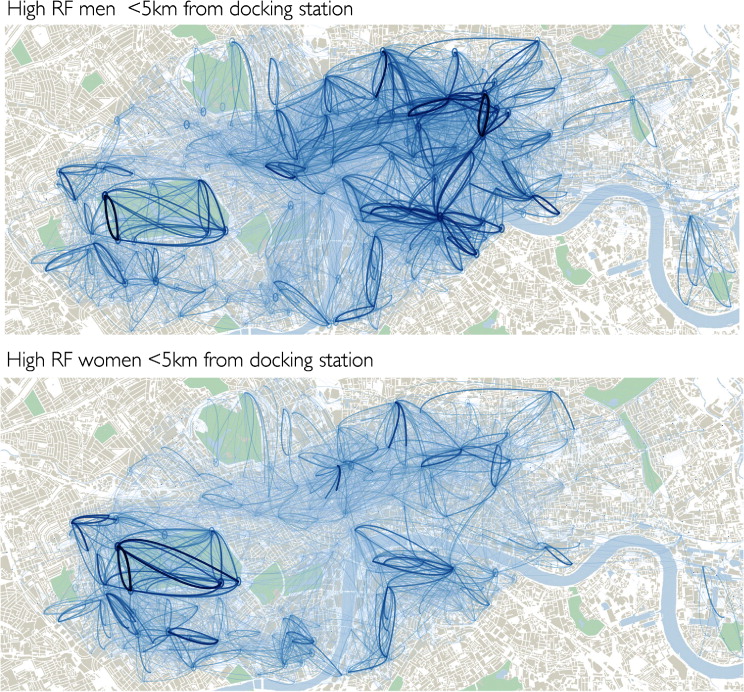
Exploring gendered cycling behaviors in London

Beecham, R., &; Wood, J. (2014). Exploring gendered cycling behaviours within a large-scale behavioural data-set. Transportation Planning and Technology, 37(1), 83-97.

Abstract
Analysing over 10 million journeys made by members of London's Cycle Hire Scheme, we find that female customers' usage characteristics are demonstrably different from those of male customers. Usage at weekends and within London's parks characterises women's journeys, whereas for men, a commuting function is more clearly identified. Some of these variations are explained by geo-demographic differences and by an atypical period of usage during the first three months after the scheme's launch. Controlling for each of these variables brings some convergence between men and women. However, many differences are preserved. Studying the spatio-temporal context under which journeys are made, we find that women's journeys are highly spatially structured. Even when making utilitarian cycle trips, routes that involve large, multi-lane roads are comparatively rare, and instead female cyclists preferentially select areas of the city associated with slower traffic streets and with cycle routes slightly offset from major roads.

credit: Beecham & Wood (2014)

ps. Interesting paper. I'm not sure what exactly the authors mean by "utilitarian cycle trips", though. I would like to see a more in depth discussion on the root causes of travel behavior differences by gender. It's a great work, though and the authors have a another paper where they focus on the methodology they've used.

Saturday, October 15, 2016

Visualizing the space-time geography of flow data

Till Nagel and Christopher Pietsch have created an art installation that allows one to visualize and compare the spaces of flow created by bike-sharing systems in New York City, Berlin, and London. The name of the project is city flow, a comparative visualization environment of urban bike mobility. They have recently published a paper (co-authored with Marian Dörk) with more technical information about their project.

These guys are doing a fabulous work with design, and I believe they're really pushing the boundary of data visualization in urban and transport studies with new tools to visualize the space-time geography of flow data. 

Take a look at how easy it gets to explore trajectories of cyclists in space and time with their tool.

Tuesday, October 11, 2016

Cycle infrastructure is democracy in motion

A picture is worth a thousand words:


Wednesday, September 28, 2016

#wherearetheracks in Cambridge ?

I took this picture yesterday near the train station at Cambridge UK. I confess I'm surprised with how poor is cycling infrastructure in Cambridge given that this is the city with the highest share of commutes by bike in Britain. Without much ambition, I'm starting the hashtag #wherearetheracks in Twitter to raise awareness of local authorities about the lack of cycling racks in their communities.  

This is the least that happens where there is a lack of cycling infrastructure. 

#wherearetheracks in Cambridge ?
image credit: Rafael Pereira

Monday, July 25, 2016

Differences across cycling policies in one image


Tuesday, July 5, 2016

Active transportation in Brazil

alert of shameless self-promotion 
"Approximately a third of men and women actively commute to work in Brazil, similar to European countries such as France (34.9%) and Holland (37.9%), and below the rates found in China (46.1%)."

This is from a paper I have recently published with colleagues. The paper has been published in both English and Portuguese. Details below.

Sá, T. H. de, Pereira, R. H. M., Duran, A. C., & Monteiro, C. A. (2016). Socioeconomic and regional differences in active transportation in Brazil. Revista de Saúde Pública, 50. doi:10.1590/S1518-8787.2016050006126

Abstract:
OBJECTIVE: To present national estimates regarding walking or cycling for commuting in Brazil and in 10 metropolitan regions.
METHODS: By using data from the Health section of 2008’s Pesquisa Nacional por Amostra de Domicílio (Brazil’s National Household Sample Survey), we estimated how often employed people walk or cycle to work, disaggregating our results by sex, age range, education level, household monthly income per capita, urban or rural address, metropolitan regions, and macro-regions in Brazil. Furthermore, we estimated the distribution of this same frequency according to quintiles of household monthly income per capita in each metropolitan region of the country.
RESULTS: A third of the employed men and women walk or cycle from home to work in Brazil. For both sexes, this share decreases as income and education levels rise, and it is higher among younger individuals, especially among those living in rural areas and in the Northeast region of the country. Depending on the metropolitan region, the practice of active transportation is two to five times more frequent among low-income individuals than among high-income individuals.
CONCLUSIONS: Walking or cycling to work in Brazil is most frequent among low-income individuals and the ones living in less economically developed areas. Active transportation evaluation in Brazil provides important information for public health and urban mobility policy-making