Showing posts with label Housing. Show all posts

Monday, September 2, 2019

Who wins and who loses from rent control?

Short/simple answer: everyone loses in the long run.

Last year, I shared here a NBER Working Paper by Rebecca Diamond (Stanford) and colleagues on the effects of rent control on tenants, landlords, and inequality. This issue always makes a comeback and since the paper has has now been published on AER, I thought it would be good to post about this study again. Thanks Max Roser and Carlos Goes for the pointers

Diamond, Rebecca, Tim McQuade, and Franklin Qian. 2019. The Effects of Rent Control Expansion on Tenants, Landlords, and Inequality: Evidence from San Francisco. American Economic Review, 109 (9): 3365-94. [ungated version of the paper]

Abstract
Using a 1994 law change, we exploit quasi-experimental variation in the assignment of rent control in San Francisco to study its impacts on tenants and landlords. Leveraging new data tracking individuals' migration, we find rent control limits renters' mobility by 20 percent and lowers displacement from San Francisco. Landlords treated by rent control reduce rental housing supplies by 15 percent by selling to owner-occupants and redeveloping buildings. Thus, while rent control prevents displacement of incumbent renters in the short run, the lost rental housing supply likely drove up market rents in the long run, ultimately undermining the goals of the law.

Sunday, August 19, 2018

The urban landscape of Hong Kong

Johnny Harris (Vox) has filmed a great series of short-videos that helps us understand the urban landscape of Hong Kong. In one of these videos, Johnny talks about how one of the most unaffordable housing markets in the world is driven by government's land-use regulations. The videos also cover the decline of Hong Kong's neon nightscape and even how feng shui shapes the city skyline. There is also a very informative one about the changing relationship between Hong Kong and China. You can check the list of videos below.


Sunday, April 22, 2018

Mass housing aerial photography in Mexico

“High Density”, a photo essay by Jorge Taboada addressing the proliferation of large and segregated complexes of social housing in Mexico. Hat tip Yuri Gama


Wednesday, January 31, 2018

How much residential space could you rent with $1,500 in 30 global cities?

I saw this chart on Twitter via Simon Kuestenmacher.

Infographic: Where Renters Get the Most and Least Space | Statista You will find more statistics at Statista

Related posts:
  1. Comparing house price trends worldwide
  2. The effects of rent control on tenants, landlords, and inequality
  3. Aggregate homeownership rates for different countries
  4. Map of real estate prices in Sao Paulo
  5. Empty spaces in the crowd: Residential vacancy in São Paulo


UPDATE [6 Feb 2018] Apparently, the data is for 2016. The source of the date is a real state intelligence company called Yardi Matrix. They have another version of the chart that includes the 100 most populous cities in the US.

How much residential space could you rent with $1,500 in the 100 most populous US cities?


Tuesday, January 9, 2018

The effects of rent control on tenants, landlords, and inequality

Good read on the effects of rent control. There are many interesting results and Damon Jones presents a very good summary and discussion in this thread.

Diamond, R., McQuade, T., & Qian, F. (2018). The Effects of Rent Control Expansion on Tenants, Landlords, and Inequality: Evidence from San Francisco. NBER Working Paper No. 24181

Abstract:
We exploit quasi-experimental variation in assignment of rent control to study its impacts on tenants, landlords, and the overall rental market. Leveraging new data tracking individuals’ migration, we find rent control increased renters’ probabilities of staying at their addresses by nearly 20%. Landlords treated by rent control reduced rental housing supply by 15%, causing a 5.1% city-wide rent increase. Using a dynamic, neighborhood choice model, we find rent control offered large benefits to covered tenants. Welfare losses from decreased housing supply could be mitigated if insurance against rent increases were provided as government social insurance, instead of a regulated landlord mandate.

Sunday, December 11, 2016

Comparing house price trends worldwide

Leonard Kiefer has a new post where he presents some interesting analysis of global house price trends. Lonards has used data from the international house price database, organized by the Dallas Federal Reserve Bank.

The analysis is written in R and the code is available at the bottom of his post. Thanks Leonard!

ps. don't forget to check the related links at the bottom of this post.

credit: Leonard Kiefer


Related Links:

Friday, September 30, 2016

Empty spaces in the crowd: Residential vacancy in São Paulo

Nadalin, V., & Igliori, D. (2016). Empty spaces in the crowd. Residential vacancy in São Paulo’s city centre. Urban Studies, DOI: 10.1177/0042098016666498.

Abstract
In the past decades, when São Paulo became the national manufacturing centre, it has experienced great population growth. Since then, many housing problems have emerged. In addition, the difficulties that inner cities face in attracting jobs and maintaining economic activities are particularly challenging. Indeed, even if many cities have successfully regenerated their central areas, the so-called inner city problem is still very much alive in the case of São Paulo. As a result although the city centre has abundant urban infrastructure it still has plenty of vacant spaces, including residential buildings. One could say that São Paulo’s city centre is characterised by a large number of empty spaces in an area that is simultaneously crowded with buildings and urban facilities. This paper intends to contribute to the empirical analysis of the determinants of vacancy rates, with a particular focus on historical city centres, using São Paulo Metropolitan Area as our case study. Our empirical analysis relies on district-level data for the years 2000 and 2010, and combines standard spatial econometric methods with hedonic modelling. Our results suggest that there are three main groups of determinants: individual buildings characteristics, mobility of households and neighbourhood quality. We find evidence that the historic central city is a distinctive submarket, needing special urban policies. Its determinants work differently when compared with the housing markets of other areas across the city.
credit: Nadalin & Igliori, 2016

Monday, August 29, 2016

Aggregate homeownership rates for different countries

Quartz has an interesting piece on why most Germans prefer renting instead of buying their homes. (via Simon Kuestenmache). The data in this chart is a bit outdated but homeownership rate was still relatively low in Germany in 2013, at 43%. In Brazil, this rate was 75% in the year 2011.


Friday, February 19, 2016

Commuting times and housing costs in eight major cities

Alan Smith has put together a nice series of charts comparing commuting times and housing costs compared in eight major cities for a piece in the FT. Good read. I thank Jakob Engel for the pointer.


Thursday, January 14, 2016

Map of real estate prices in Sao Paulo

Great interactive map with real estate prices in Sao Paulo, Brazil. The data used in the map is available here and covers 200 thousand properties announced for sale in a real state agency website (Properati).

credit: Properati

Saturday, October 25, 2014

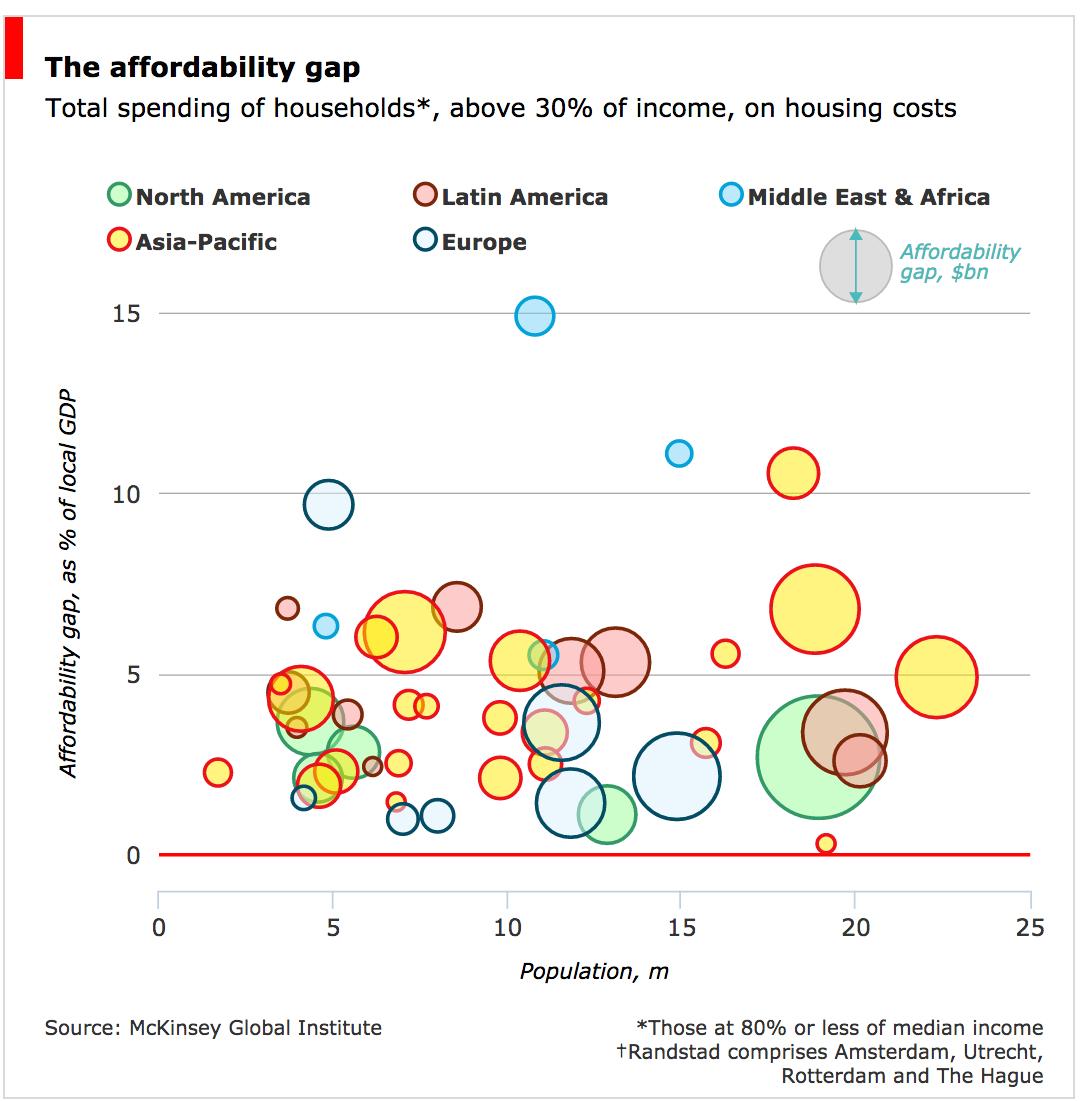
Which cities have least affordable housing?

A new report by McKinsey Global Inst. compares housing affordability across 100 cities. HT/ the Daily Charts team at The Economist, who came up with a nice interactive chart.


[image credit: The Economist]


Tuesday, September 17, 2013

The Causes of Informal Housing - EPAINOS 2013 Prize Winner

Every year, the European Regional Science Association (ERSA) gives the EPAINOS award to a young scientist, under 33 years old. It makes me very glad to know that this years’ winner is Daniel da Mata!  Daniel has just finished his PhD in economics at Cambridge University and he is a brilliant researcher we have here at Ipea (Institute for Applied Economic Research).

Here is his awarded paper: "Disentangling the Causes of Informal Housing"

Abstract:
"This article aims to measure the main determinants of the expansion of informal settlements. The focus is on how urban poverty, rural-urban migration and land use regulations impact the growth of slums. I construct a structural model to explain the determinants of informal housing. The model supports the main empirical evidence regarding slums formation and it is able to quantitatively assess the role of each determinant of slums growth. The model is calibrated and estimated to be consistent with several statistics related to the Brazilian urbanization process from 1980 to 2010. I present several counterfactual experiments to assess the role of income, migration and land use regulation. The results show that these factors explain about half of the variation in slums growth between 1980 and 2010. I also perform ex-ante evaluation of the impacts of slum upgrading interventions and show how policies may have unintended adverse effects on slums formation."


By the way: Guilherme Resende was awarded the EPAINOS prize in 2009. Guilherme is another great researcher at Ipea.


Wednesday, September 4, 2013

Wednesday, May 29, 2013

The importance of titling and property rights

A 10-minute video from MRUniversity course on development economics covering the theory and empirical research on the importance of titling and property rights (via Alex Tabarrok).